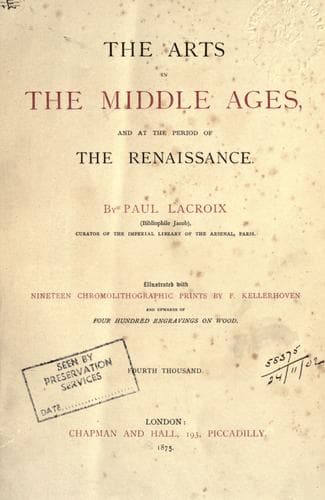
The Arts in the Middle Ages and at the Period of the RenaissanceJacob, P. L.
History
The Arts in the Middle Ages and at the Period of the Renaissance
Jacob, P. L.
Art, Medieval; Art, Renaissance; Middle Ages
In Spain a strange combat was waging on the soil itself, for the
possession of which two hostile races, two irreconcilable faiths, were
in fierce contention. The Mahometan built the Alhambra, the halls of
which were destined to be subsequently adorned by a Christian pencil. In
the paintings that enliven the arches of this marvellous edifice an art
is manifested which is both simple and grand in its character; but in
this one undertaking it appears to have exhausted the share of vitality
time had awarded to it; for immediately afterwards it seems to have died
away. If, however, any fresh masters of the art of painting appeared on
the Iberian soil, they had sought in Italy the flame of inspiration, or
some mighty art-pilgrim visited their country. We must come down to a
later epoch, from the consideration of which we are now precluded, in
order to meet with an Herrera, a Ribera, a Velasquez, or a Murillo, the
glory of whom, although comparatively late, may perhaps hold its own by
the side of the great Italian schools, but cannot pretend to eclipse
them. Among the predecessors of these real and distinct individualities,
we will, however, mention the following:--Alonzo Berruguete, born in
1480, at once painter, architect, and sculptor; he was a pupil of
Michael Angelo, in whose works he often took a share; Pedro Campagna,
born in 1503, who studied under the same master--his _chef-d’œuvre_ is
still admired in the Cathedral of Seville; Luis de Vargas, born in 1502,
who was able in many points to appropriate the secrets of Sanzio, from
whom he appeared to have received lessons; Morales, whose paintings are
still admired for the harmony of their lines and the delicacy of their
touch; Vicente Juanes, whose purity of design and sober vigour of
colouring obtained for him the title (certainly by some exaggeration of
praise) of the “Raphael of Valencia;” lastly, Fernandez Navarette, born
in 1526, who, perhaps less hyperbolically, was surnamed the “Spanish
Titian;” and Sanchez Coello, born about 1500, who, excelling in
portraits, has handed down the likenesses of some celebrated personages
of his time.
Public-domain text, read in full here on John Shaqi.
Reviews
Reviews
No reviews yet
Be the first to share your thoughts on this work.
Elsewhere in the archive
Join the Discussion
Join the discussion
Sign in to leave a comment or review.
Sign InorCreate an account