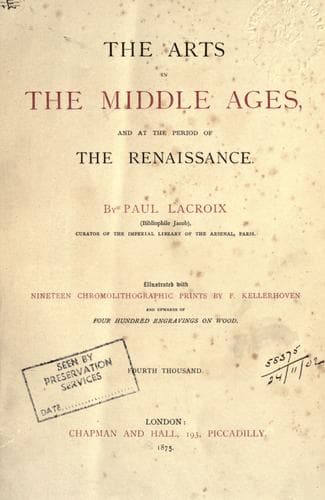
The Arts in the Middle Ages and at the Period of the RenaissanceJacob, P. L.
History
The Arts in the Middle Ages and at the Period of the Renaissance
Jacob, P. L.
Art, Medieval; Art, Renaissance; Middle Ages
In Germany and the Low Countries we find similar traces of the feeling
of regeneration actuating the minds of artists at a much earlier period.
The first name which presents itself to us beyond the Rhine is that
mentioned in the Chronicle of Limburg, of the date of 1380. “There was
then at Cologne,” says the chronicler, “a painter named Wilhelm.
According to the masters, he was the best in all the countries of
Germany; he has painted men of every description as if they were alive.”
We have nothing left of the works of this artist except some panels
without signature, which, in consideration of the date they bear, are
attributed to him; an examination shows that, considering the epoch at
which he lived, Wilhelm might justly be looked upon as a creative
genius. He was succeeded by his most talented pupil, _Maître_ Stephan. A
triptych of his work may be seen at the Cathedral of Cologne,
representing “The Adoration of the Magi,” “St. Gereon,” “St. Ursula,”
and “The Annunciation.” This work, which exhibits charming finish as
well as harmonious simplicity, is sufficient evidence that its author
was possessed of much natural ability as well as a certain extent of
knowledge; and if we make it our study to seek out the relics of the
artistic movement of the period, we can in no way feel surprise at
seeing that the influence of this early master made itself felt in a
very extended radius.
But at this epoch, that is, at the commencement of the fifteenth
century, in a city of Flanders, a new luminary made its appearance,
which was destined to eclipse the brilliancy of the somewhat weak German
innovation. Two brothers, Hubert and John van Eyck, together with their
sister Margaret, established themselves in the “triumphant city of
Bruges,” as it is called by an historian; and very soon all the Flemish
and Rhenish regions resounded with the name of Van Eyck, their works
being the only representations which were admired and followed; and even
in those early days it was a title of glory to form a part of their
brilliant school.
Public-domain text, read in full here on John Shaqi.
Reviews
Reviews
No reviews yet
Be the first to share your thoughts on this work.
Elsewhere in the archive
Join the Discussion
Join the discussion
Sign in to leave a comment or review.
Sign InorCreate an account