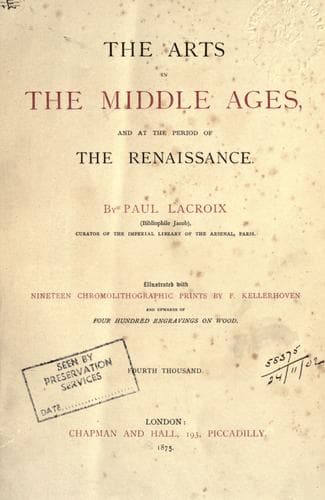
The Arts in the Middle Ages and at the Period of the RenaissanceJacob, P. L.
History
The Arts in the Middle Ages and at the Period of the Renaissance
Jacob, P. L.
Art, Medieval; Art, Renaissance; Middle Ages
A century sufficed to bring the Pointed style to its highest perfection.
Notre-Dame (Fig. 307) and the Sainte-Chapelle, in Paris; Notre-Dame,
Chartres; the cathedrals of Amiens (Fig. 308), Sens, Bourges, Coutances,
in France; those of Strasbourg, Fribourg, Altenberg, and Cologne, in
Germany, the dates of whose construction succeed each other at intervals
from the first half of the twelfth to the middle of the thirteenth
century, are so many admirable specimens or types of this art, which we
may here call relatively new.
To know to what marvellous variety of combinations and effects, by
merely modifying it in height and breadth from its original type, this
pointed arch, which, taken by itself, might appear the simplest of
forms, can attain, one must have passed some time in dividing into the
different parts of which it is composed, by an accurate examination of
its _tout ensemble_, such an edifice as Notre-Dame, Paris, or as the
Cathedral of Strasbourg; the first of which attracts attention by the
sustained boldness of its lines, strong as they are graceful; the
second, by its perfectly bold independence, seeming, as it does, to
taper away as by enchantment, in order to bear to a surprising height
the evidence of its incomprehensible temerity.
We must rise in thought above the edifice to grasp the plan of its first
conception; we must, from below, study it on all sides to perceive
[Illustration: Fig. 307.--Notre-Dame, Paris (Twelfth and Thirteenth
Centuries).
View of the principal Façade before the restoration executed by Messrs.
Lassus and Viollet-le-Duc.]
[Illustration: Fig. 308.--Interior of Amiens Cathedral. (Thirteenth
Century.)]
with what art its various parts are arranged, grouped, placed at certain
intervals from each other; we must seek to discover the contrivance by
virtue of which the immense _évidage_ (sloping) of numerous buttresses,
the height of the towers, the retiring of the laterals, and the curve of
the apse are harmonised; we must enter the church and stand in its nave,
with its interminable delicate ribs--how many clusters of small columns
extend above the slender pillars!--we must contemplate the beautiful
fancies of the rose-windows, which by their many-coloured glass sober
down the glare of the light passing through them; we must gain the
summit of those towers, those spires, and from them command the dizzy
extent of aërial
[Illustration: Fig. 309.--Capital of a Column in the Abbey of St.
Geneviève (destroyed), Paris.
(Eleventh Century.)]
[Illustration: Fig. 310.--Capital of a Column in the Church of St.
Julien the Poor (destroyed), Paris.
(Twelfth Century.)]
Public-domain text, read in full here on John Shaqi.
Reviews
Reviews
No reviews yet
Be the first to share your thoughts on this work.
Elsewhere in the archive
Join the Discussion
Join the discussion
Sign in to leave a comment or review.
Sign InorCreate an account