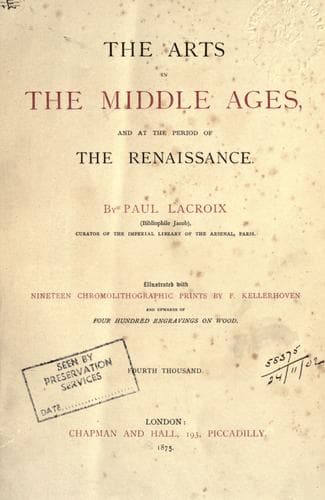
The Arts in the Middle Ages and at the Period of the RenaissanceJacob, P. L.
History
The Arts in the Middle Ages and at the Period of the Renaissance
Jacob, P. L.
Art, Medieval; Art, Renaissance; Middle Ages
It is probable that with the Romans, papyrus, considering the facility
they had of procuring it for themselves, was more frequently used than
parchment, which, at first, was rare and costly. But parchment, more
durable and of greater resistance than papyrus, was reserved for the
transcription of the most important works. Cicero, who had many books on
parchment in his magnificent library, said that he had seen the “Iliad”
copied on a scroll of _pergamena_ which went into a nut-shell. Many of
Martial’s epigrams prove to us that in the time of this poet books of
such kind were still more numerous. Unfortunately, there remains to us
no writing on parchment dating from this distant period. The Virgil in
the Vatican, and the Terence at Florence, are of the fourth and fifth
century of our era. Admitting that time destroys all, and also that the
work of the rude tribes on many occasions assisted this natural cause of
destruction, we must not forget that at certain periods, to supply the
place of new parchment when it was scarce, a plan had been devised of
making the parchment rolls which had already been used for manuscripts
serve again
[Illustration: Fig. 328.--Miniature of the Ninth Century, representing
an Evangelist who is transcribing with the _Calamus_, on Parchment, the
Sacred Text, of which he is receiving the revelation.
(Bibl. de Bourgogne, Brussels.)]
for a similar purpose, either by scraping and rubbing them with
pumice-stone, or by boiling them in water or soaking in lime. There is
no doubt but the scarceness and the dearness of parchment was the cause
of the loss of very many excellent works. Muratori cites, for example, a
manuscript of the Ambrosian Library, of which the writing, dating from
eight or nine centuries back, had been substituted for another of more
than a thousand years old; and Maffei informs us that the employment of
ancient parchment scraped and washed became so general, in the
fourteenth and fifteenth centuries, throughout Germany, that the
Emperors put a stop to this dangerous abuse by issuing an order to the
notaries to use nothing but parchment “quite new.”
[Illustration: Fig. 329.--View of the Ancient Abbey of St. Denis and its
Dependencies.]
Generally, the quality of parchment serves to determine the date of its
manufacture. The vellum of manuscripts till the middle of the eleventh
century is very white and thin; the parchment of the twelfth century is
thick, rough, and brownish, which often shows it has been scraped or
washed. The greater number of fine manuscripts are on
[Illustration: Fig. 330.--Seal of the University of Paris (Fourteenth
Century), after one of the Dies preserved in the Collection of Medals in
the Imperial Library, Paris.]
Public-domain text, read in full here on John Shaqi.
Reviews
Reviews
No reviews yet
Be the first to share your thoughts on this work.
Elsewhere in the archive
Join the Discussion
Join the discussion
Sign in to leave a comment or review.
Sign InorCreate an account