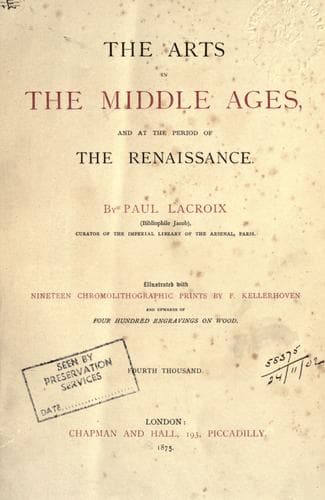
The Arts in the Middle Ages and at the Period of the RenaissanceJacob, P. L.
History
The Arts in the Middle Ages and at the Period of the Renaissance
Jacob, P. L.
Art, Medieval; Art, Renaissance; Middle Ages
The greater number of rich manuscripts, even when they contained the
text of some ancient secular author, were destined to be presented to
the treasuries of churches and abbeys, and these offerings were not made
without great display: the book, whatever its contents might be, was
placed on the altar, and a solemn mass was celebrated on the occasion;
moreover, an inscription at the end of the work mentioned the homage
which had been paid for it to God and to the saints in paradise.
We must not forget that in this time of almost universal ignorance, the
Church was the only depository of literature and science; she sought
after those heathen authors who could instruct her in eloquence that
might be employed in advancing the faith, almost as much as she sought
for sacred books; it was not rare even to see Christian zeal exalting
itself so far as to find prophets of the Messiah in writers very
anterior to the doctrines of Christ. Thus the best Greek and Latin
manuscripts of profane authors are the work of monks, as were the Bibles
and the writings of the Fathers of the Church. The rules of the most
ancient brotherhoods recommended the monks who could write and who
wished to please God to re-copy the manuscripts, and those who were
illiterate to learn to bind them. “The work of the copyist,” said the
learned Alcuin to his contemporaries, “is a meritorious work, which is
profitable to the soul, while the work of the ploughman is profitable
only to the belly.”
At all periods of history we find mention made of certain celebrated
manuscripts. We will not go so far back as the Greek traditions relating
to the works of Homer, of which some copies were ornamented with a
richness that has, probably, never been surpassed. In the fifth century
St. Jerome possessed twenty-five parts of the works of Origen, which
Pamphilus the Martyr had copied with his own hand. St. Ambrose, St.
Fulgentius, Hincmar, Archbishop of Rheims, men as learned as they were
pious, applied themselves to reproducing with their own hands the best
ancient texts. A copyist by profession was called _scriba_, _scriptor_;
the place in which they generally worked was called _scriptorium_. The
capitularies against bad copyists were frequently renewed. “We ordain
that no scribe write incorrectly,” we find in the collection of Baluze.
We read in the same collection, in 789, “There shall be good Catholic
texts in all monasteries, so that prayers shall not be made to God in
faulty language.” In 805, “If the Gospels, the Psalter, or the Missal
are to be copied, only careful middle-aged men are to be employed;
verbal errors may otherwise be introduced into the faith.” There were,
moreover, _correctors_ who rectified the work of the copyists, and
attested the work, on the volumes, by the words _contuli_, _emendavi_
(“I have collated, I have revised”). A copy of Origen’s works has been
mentioned, corrected by the hand of Charlemagne himself, to whom is also
Public-domain text, read in full here on John Shaqi.
Reviews
Reviews
No reviews yet
Be the first to share your thoughts on this work.
Elsewhere in the archive
Join the Discussion
Join the discussion
Sign in to leave a comment or review.
Sign InorCreate an account