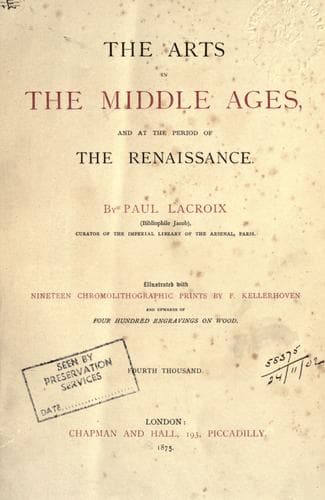
The Arts in the Middle Ages and at the Period of the RenaissanceJacob, P. L.
History
The Arts in the Middle Ages and at the Period of the Renaissance
Jacob, P. L.
Art, Medieval; Art, Renaissance; Middle Ages
attributed the introduction of full stops and commas.
The same care presided over the preparation of royal charters and
diplomas; the referendaries or chancellors drew them up and
superintended their despatch; the principal officers of the crown
intervened, as guarantors or witnesses to them, and these acts were read
publicly before they were signed and sealed. Notaries and witnesses
guaranteed the authenticity of private charters.
As long as printing did not exist in France, the corporation of scribes,
copyists of charters, and copyists of manuscripts, which counted among
them booksellers, was very numerous and very influential, since it was
composed of graduates of the university that patronised them and placed
them among the number of its indispensable agents. He who desired to
become a bookseller had to give proof of his instruction and of his
ability; he was obliged to take an oath “not to commit any deception,
fraud, or evil thing which might damage or prejudice the university, its
scholars and frequenters, nor to rob nor speak ill of them.” Besides
which he was compelled to deposit a sum of fifty francs (_livres
parisis_) as caution-money.
The rules imposed on scribes and on booksellers were always very strict,
and this severity was only too justly occasioned by the abuses that
existed, and by the scandalous disorder of the people who exercised
these professions. In the year 1324 the university published this
order:--“There will be admitted only people of good conduct and morals,
sufficiently acquainted with the book trade, and previously approved by
the university. The bookseller may not take a clerk into his service
till that clerk has sworn, before the university, to exercise his
profession according to the ordinances. The bookseller must give to the
university a list of the works which he sells; he must not refuse to let
a manuscript to whomsoever may wish to make a copy of it, on payment of
the indemnity fixed by the university. He is forbidden to let out books
that have not been corrected, and those students who find an incorrect
copy are requested to denounce it publicly to the rector, so that the
bookseller who has let it out may be punished, and that the copy may be
corrected by _scholares_ (learned men or scholars). There shall be every
year four commissioners chosen to fix the price of books. One bookseller
shall not sell a work to another bookseller before he has exposed the
work for sale during four days. In any case the seller is obliged to
register the name of the purchaser, to describe him, and to state the
price for which the book was sold.”
Public-domain text, read in full here on John Shaqi.
Reviews
Reviews
No reviews yet
Be the first to share your thoughts on this work.
Elsewhere in the archive
Join the Discussion
Join the discussion
Sign in to leave a comment or review.
Sign InorCreate an account