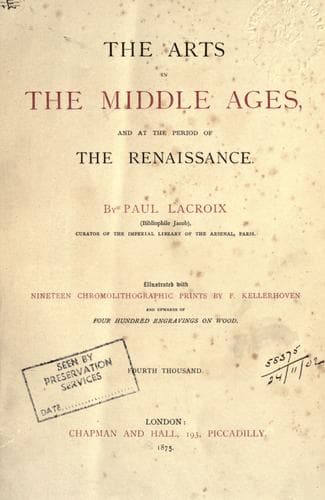
The Arts in the Middle Ages and at the Period of the RenaissanceJacob, P. L.
History
The Arts in the Middle Ages and at the Period of the Renaissance
Jacob, P. L.
Art, Medieval; Art, Renaissance; Middle Ages
From century to century this legislation underwent variations, according
to the ideas of the times: and when the printing-press came, in the
middle of the fifteenth century, to change the face of the world, the
corporation of _scribes_ rose at first against the new art which was to
ruin them. “But at last,” says Champollion-Figeac, “they submitted, and
temporary measures were recommended to the public authorities for the
defence of an ancient order of things which could not long resist the
new.”
Now let us go back to the first centuries of the Middle Ages, to resume
the question from a palæographic point of view.
The languages and literature of modern Europe are all Greek or Latin,
Sclavonic or Gothic; these four great families of peoples and of
languages have existed in spite of the vicissitudes of politics. Such is
the basis whereon must be found all the researches by which we are to
establish the origin and nature of the writing peculiar to each
literature.
The Greeks of Constantinople taught writing to the Sclavonic race, and
with it the Christian faith. The most ancient Greek writing (we speak of
the Christian era only) was the _capital_ writing, regular and
well-proportioned; as it became general it was simplified more and more.
After this sort of writing, examples of which are found only on stone or
bronze, we come to the writing called, although we do not know why,
_uncial_,[53] which, was the first step towards the Greek _cursive_
(flowing).
_Uncial_ writing was employed, in Greek manuscripts, up to the ninth
century; we may observe the transition from the _uncial_ to the
_half-uncial_, and from the _half-uncial_ to the _minuscule_.[54] In the
tenth century manuscripts in minuscule became very abundant--the
tachygrapher’s (ταχὑς, quick, and γρἁφω, I write), or the partisans of
quick writing, gained the day; the caligraphers (καλὁς, beautiful, and
γρἁφω I write) desired to follow their example. These employed a great
deal of time in painting the initials of running letters: the new
method, which produced more in the same space of time, easily got into
favour; the caligraphers abandoned the uncial and adopted the minuscule
characters connected together, which combined good forms with greater
facility of execution. Thenceforward, the uncial was no longer employed
except for the titles or headings of books.
Public-domain text, read in full here on John Shaqi.
Reviews
Reviews
No reviews yet
Be the first to share your thoughts on this work.
Elsewhere in the archive
Join the Discussion
Join the discussion
Sign in to leave a comment or review.
Sign InorCreate an account