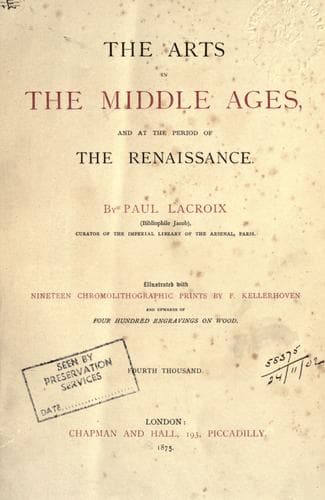
The Arts in the Middle Ages and at the Period of the RenaissanceJacob, P. L.
History
The Arts in the Middle Ages and at the Period of the Renaissance
Jacob, P. L.
Art, Medieval; Art, Renaissance; Middle Ages
Among the fine specimens of this epoch which have been preserved, we may
mention, in the Imperial Library of Paris, a Book of the Gospels, called
Cardinal Mazarin’s, and the Commentaries of Gregory Nazianzus; at the
Laurentinean Library, Florence, are a Plutarch and a Book of the
Gospels, written with gold ink in large and massive minuscule cursive
characters; and lastly, a book of ecclesiastical offices, belonging also
to the Imperial Library in Paris, and which bears this superscription in
Greek:--“Pray for Euthymus, a poor monk, priest of the monastery of St.
Lazare. This volume was finished in the month of May, Convocation S, in
the year 6515,” a date which, according to the computation of the Greek
Church, corresponds to the month of May of the year 1007 of the
Christian era.
To the twelfth century is assigned the beautiful Greek manuscript which
was afterwards given to Louis XIV. by Chrysanthes Noras, Patriarch of
Jerusalem; to the thirteenth century belongs another manuscript, in very
small cursive letters, ornamented with portraits, presented by the
Emperor Palæologos to St. Louis. It was only in the fourteenth century
that manuscripts half Latin and half Greek, appeared. Lastly came Ange
Végèce, of Corfu, who, towards the middle of the fifteenth century, made
for himself, as a Greek caligrapher, such a reputation that he gave, it
is said, rise to the proverb, “_Écrire comme un ange_.”
The Greek alphabet, when it penetrated into the countries of the north
with the Christian religion and civilisation, underwent important
modifications. On the right bank of the Danube, in ancient Mœsia,
Ulphilas, the descendant of a Cappadocian family formerly taken prisoner
by the Goths, invented, in the fourth century, the alphabet bearing, on
that account, the name of _Mœso-Gothic_, and which is of Greek origin,
with a mixture of Latin characters and other peculiar signs. This
writing is heavy, without being elegant; differing, as if by an instinct
of nationality, from the types which it imitates. The Mœso-Gothic
manuscripts are, however, very rare; only two or three being known.
Public-domain text, read in full here on John Shaqi.
Reviews
Reviews
No reviews yet
Be the first to share your thoughts on this work.
Elsewhere in the archive
Join the Discussion
Join the discussion
Sign in to leave a comment or review.
Sign InorCreate an account