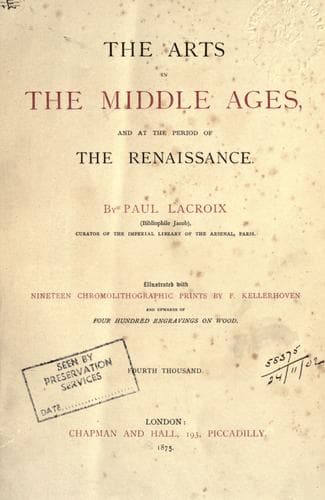
The Arts in the Middle Ages and at the Period of the RenaissanceJacob, P. L.
History
The Arts in the Middle Ages and at the Period of the Renaissance
Jacob, P. L.
Art, Medieval; Art, Renaissance; Middle Ages
[Illustration: Fig. 342.--Diplomatic Writing of the Tenth Century, from
a Charter of Hugh Capet. (Archives of the Empire.)
This Fac-simile gives only half the length of the lines.
TEXT (completely restored.)--_In nomine sanctæ et individuæ Trinitatis,
Hugo gratia Dei Francorum rex. [Mos et consuetudo regum prædecessorum
nostrorum semper exstitit ut ecclesias Dei sublimarent et justis
petitioni]bus servorum Dei clementer faverent, et oppression[em eorum
benigne sublevarent, ut Deum propitium] haberent, eujus amore id
fecissent. Hujus rei grati[a, auditis clamoribus venerabilis Abbonis
abbatis] monasterii S. Mariæ, S. Petri et S. Benedicti Flori[acensis et
monachorum sub eo degentium, nostram] presentiam adeuntium, pro malis
consuetudi[nibus et assiduis rapinis_ ...
TRANSLATION.--In the name of the holy and indivisible Trinity, Hugh, by
the grace of God, King of the Francs.
The custom and habit of the kings our predecessors has always been to
honour the churches of God, and to show themselves mercifully favourable
to the just petitions of the servants of God, and to deliver them kindly
from oppression, so that God might be propitious to them, for the love
of whom they thus acted. For this cause, having heard the complaints of
the venerable Abbon, Abbot of the Monastery of Our Lady, St. Peter and
St. Benedict, of Fleury-sur-Loire, and those of the monks living under
his direction, and who came into our presence, on account of the bad
customs and continual rapines ...]
[Illustration: Fig. 343.--Cursive Writing of the Fifteenth Century,
after an Original Letter, taken from “Recueil des Lettres de Rois.”
(Imperial Library, Paris.)
TEXT.--_Messeigneurs et freres, si tres humblement que faire puis a voz
bonnes graces me recommande. Messeigneurs, j’ay receu, voz lettres par
le present porteur: ensemble la requeste et arrest de la court par
icelle ensuivy. J’ay le tout communiqué a messeigneurs les generaulx de
Langue doil et Normandie, et nous avons souuant esté ensemble. Ilz
trouuent bien estrange, aussi font daultres, qui zelent le bien et
honneur de la chambre ausquelz pareillement_ ...
TRANSLATION.--My lords and brothers, I commend myself as humbly as
possible to your good graces. My lords, I received your letters by the
bearer of this, together with the petition and the decree of the court
accompanying them. I communicated the whole to my lords the generals of
La Langue d’Oil and of Normandy, and we have often conferred together on
the matter. They think it very strange, as do others also, who are
zealous for the good and the honour of the chamber, to which equally
...]
[Illustration: Fig. 344.--Writing of the Fourteenth Century, after a
Manuscript of “L’Histoire Romaine;” being a paraphrase of the text of
Valerius Maximus. (Imperial Library, Paris.)
Public-domain text, read in full here on John Shaqi.
Reviews
Reviews
No reviews yet
Be the first to share your thoughts on this work.
Elsewhere in the archive
Join the Discussion
Join the discussion
Sign in to leave a comment or review.
Sign InorCreate an account