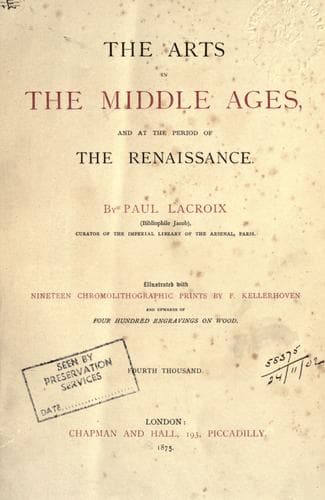
The Arts in the Middle Ages and at the Period of the RenaissanceJacob, P. L.
History
The Arts in the Middle Ages and at the Period of the Renaissance
Jacob, P. L.
Art, Medieval; Art, Renaissance; Middle Ages
All the Arts are interesting in themselves. Their productions awaken
attention and excite curiosity. But here it is not one Art only that is
treated of. We pass in review all the Arts, starting from the fourth
century to the second half of the sixteenth--Architecture raising
churches and abbeys, palaces and public memorials, strong fortresses and
the ramparts of cities; Sculpture adorning and perfecting other Arts by
its works in stone, marble, bronze, wood, and ivory; Painting,
commencing with mosaic and enamels, contributing to the decoration of
buildings jointly with stained glass and frescoes, embellishing and
illuminating manuscripts before it arrived at its highest point of
perfection, with the Art of Giotto and Raphael, of Hemling and Albert
Dürer; Engraving on wood and metal, with which is associated the work of
the medallist and the goldsmith; and after attempting to touch upon
Playing-cards and Niello-work, we suddenly evoke that sublime invention
destined to change the face of the world--Printing. Such are, in brief,
some of the principal features of this splendid picture. One can imagine
what an infinity, what variety and richness, of details it should
contain.
Our subject presents, at the same time, another kind of interest more
elevated and not less alluring. Here each Art appears in its different
phases and in its diversified progress. It is a history, not alone of
the Arts, but of the epoch itself in which they were developed; for the
Arts, regarded in their generality, are the truest expression of
society. They speak to us of tastes, of ideas, of character: they
exhibit us in their works. Of all an age can leave to the future
concerning itself, that which represents it most vividly is Art: the
Arts of an epoch revivify it, and bring it back before our eyes.
It is this which forms our book. Yet, we must remark, here its interest
is redoubled, for we retrace not only a single era, but two eras very
distinct from each other. In the first, that of the Middle Ages, which
followed the invasion of the Northmen, society was in a great measure
formed of new and barbarous elements, which Christianity laboured to
break up and fashion. In the second epoch, on the contrary, society was
organised and firmly established; it enjoyed peace, and reaped its
fruits. The Arts followed the same phases. At first rude and informal,
they rose slowly and by degrees, like society, out of chaos. At length
they nourished in perfect freedom, and progressed with all the energy of
which the human mind is capable. Hence the successive advances whose
history presents a marvellous interest.
Public-domain text, read in full here on John Shaqi.
Reviews
Reviews
No reviews yet
Be the first to share your thoughts on this work.
Join the Discussion
Join the discussion
Sign in to leave a comment or review.
Sign InorCreate an account