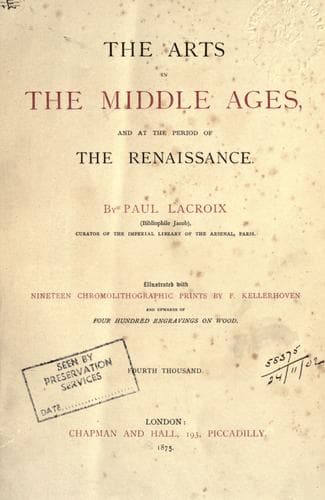
The Arts in the Middle Ages and at the Period of the RenaissanceJacob, P. L.
History
The Arts in the Middle Ages and at the Period of the Renaissance
Jacob, P. L.
Art, Medieval; Art, Renaissance; Middle Ages
During the Middle Ages, Art generally followed the inspirations of that
Christian spirit which presided at the formation of this new world. It
arose to reproduce in an admirable manner the religious ideal. Only
towards the end of that period it searched out for beauty of form, and
began to find it when the Renaissance made its appearance: the
Renaissance, that is, the intellectual revolution, which, in the
fifteenth and sixteenth centuries, restored among modern nations the
sceptre to Literature and the Arts of antiquity. Then, with the
Renaissance, the Arts changed their direction, and especially the
principal Arts, those by which the genius of man expresses most forcibly
his ideas and his feelings. Thus, in the Middle Ages, a new style of
architecture is created that rapidly attained the highest degree of
perfection, the _ogival_ (later Gothic or flamboyant), of which we see
the _chefs-d’œuvre_ in our cathedrals: at the Renaissance, this was
replaced by architecture derived from that of the Greeks and Romans,
which also produced admirable works, but almost always less in harmony
with the dignity and splendour of worship. In the Middle Ages, Painting
chiefly applied itself to represent the _beau idéal_ of the religious
mind reflecting itself in the countenance; at the Renaissance, it is the
beauty of the physical form, so perfectly expressed by the ancients.
Sculpture, which comes nearer to Painting, followed at the same time all
similar phases, drawing the art of Engraving with it. Do not the
diversified changes through which the Arts passed, as retraced in this
book during two epochs, present to the intelligent reader a succession
of facts of the highest interest and a history most instructive?
Our work is the only existing one on this great and magnificent subject,
of which the materials are scattered through a multitude of volumes.
Thus for the success of this undertaking it became necessary to unite
with us in our task men most distinguished by their learning and
talents: we are permitted to cite the names of MM. Ernest Breton, Aimé
Champollion, Champollion-Figeac, Pierre Dubois, Duchesne, Ferdinand
Denis, Jacquemart, Arch. Juvinal, Jules Labarte, Lassus, Louandre,
Prosper Mérimée, Alfred Michiels, Gabriel Peignot, Riocreux, De Saulcy,
Jean Designeur, le Marquis de Varennes. After such a list we record our
own name only to acknowledge that we have gone over and recast these
various works, and presented them in a form which gives them more unity,
but owes to them all the interest and all the charm it may offer.
The numerous illustrations that adorn the work will engage the eye,
while the text will speak to the intelligence. The designs in
chromolithography are executed by M. Kellerhoven, who for several years
has made the art one of a high order, worthy to shine among the finest
works of our greatest painters, as is proved by his “Chefs-d’œuvre of
the Great Masters,” “Lives of the Saints,” and “Legend of St. Ursula.”
Public-domain text, read in full here on John Shaqi.
Reviews
Reviews
No reviews yet
Be the first to share your thoughts on this work.
Join the Discussion
Join the discussion
Sign in to leave a comment or review.
Sign InorCreate an account