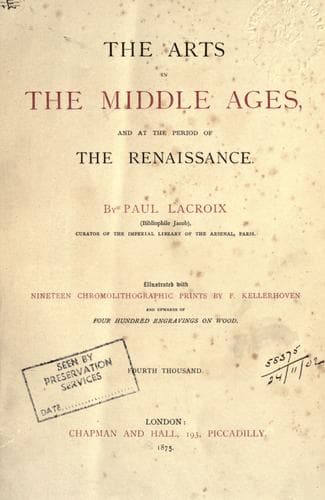
The Arts in the Middle Ages and at the Period of the RenaissanceJacob, P. L.
History
The Arts in the Middle Ages and at the Period of the Renaissance
Jacob, P. L.
Art, Medieval; Art, Renaissance; Middle Ages
produced_, should belong to the surviving partners; the heirs of the
deceased being entitled to receive no more than an indemnity of 100
florins at the expiration of the said five years.
Gutenberg accordingly offered to pay the heirs of his late partner the
stipulated sum; but they demanded of him an account of the capital
invested by Andrew Dritzehen, which, as they alleged, had been absorbed
in the speculation. They mentioned especially a certain account for
_lead_, for which their brother had made himself responsible. Without
denying this account, Gutenberg refused to satisfy their demands.
Numerous witnesses gave evidence, and their depositions for and against
the object of the association show us a faithful picture of what must
have been the inner life of four partners exhausting themselves and
their money in efforts to realise a scheme the nature of which they were
very careful to conceal, but from which they expected to derive the most
splendid results.
We find them working by night; we hear them answering those who
questioned them on the object of their work, that they were
“mirror-makers” (_spiegel-macher_); we find them borrowing money,
because they had in hand “something in which they could not invest too
much money.” Andrew Dritzehen, in whose care the _press_ was left, being
dead, Gutenberg’s first object was to send to the deceased’s house a man
he could trust, who was commissioned to unscrew the press, so that the
pieces (or _forms_), which were fixed closely together by it, might
become detached from each other, and then to place these forms in or on
the press “in such a manner that no one might be able to understand what
they were.” Gutenberg regrets that his servant did not bring him back
all the forms, many of which “were not to be found.” Lastly, we find
figuring among the witnesses a turner, a timber-merchant, and a
goldsmith who declared that he had worked during three years for
Gutenberg, and that he had gained more than 100 florins by preparing for
him “the things belonging to printing” (_das zu dem Trucken gehoret_).
_Trucken_--printing! Thus the grand word was pronounced in the course of
the lawsuit, but certainly without producing the least effect on the
audience, who wondered what was this occult _art_ which Gutenberg and
his partners had carried on with so much trouble, and at such great
expense. However, it is quite certain that, with the exception of the
indiscretion, really very insignificant, of the goldsmith, Gutenberg’s
secret remained undiscovered, for it was supposed it had to do with the
_polishing of stones_ and the manufacture of _mirrors_. The judge, being
informed as to the good faith of Gutenberg, pronounced the offers he
made to the plaintiffs satisfactory, decided against the heirs of Andrew
Dritzehen, and the three other partners remained sole proprietors of
their process, and continued to carry it out.
Public-domain text, read in full here on John Shaqi.
Reviews
Reviews
No reviews yet
Be the first to share your thoughts on this work.
Elsewhere in the archive
Join the Discussion
Join the discussion
Sign in to leave a comment or review.
Sign InorCreate an account