The Arts in the Middle Ages and at the Period of the Renaissance — John Shaqi
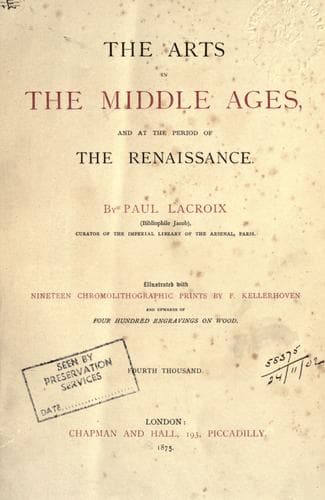
The Arts in the Middle Ages and at the Period of the RenaissanceJacob, P. L.
History
The Arts in the Middle Ages and at the Period of the Renaissance
Jacob, P. L.
Art, Medieval; Art, Renaissance; Middle Ages
We know that in the early ages of Christianity religious ceremonies were
characterised by the greatest simplicity, and that the buildings in
which the faithful were wont to assemble were for the most part devoid
of any kind of decoration. By degrees, however, rich display entered
into churches, and pomp accompanied the exercise of religious worship,
especially at the period when Constantine the Great put an end to the
era of persecutions and proclaimed himself the protector of the new
faith. It is related that among the rich presents which this emperor
distributed throughout the Christian temples in Rome, were a golden
cross weighing two hundred pounds, patens of the same metal, lamps
representing animals, &c. At a later period, in the seventh century, St.
Eloi, who was a celebrated goldsmith before he became Bishop of Noyon,
gave his whole mind and talents to the manufacture of church ornaments.
He enlisted from among the monks of the various monasteries that were
subject to his episcopal authority, all those whom he fancied had an
aptitude for these works of art; he instructed and directed them
himself, and made them excellent artists; he transformed entire
monasteries into gold and silver-smiths’ workshops; and numerous
remarkable works increased the splendour of the Merovingian basilicas;
such, for example, were the shrine of St. Martin of Tours, and the tomb
of St. Denis, the marble roof of which was profusely ornamented with
gold and precious stones. “The bounty of Charlemagne,” says M. Charles
Louandre, “added new riches to the immense wealth already accumulated in
the churches. Mosaics, sculpture, the rarest kinds of marble, were
lavished on those basilicas for which the emperor evinced partiality;
but all these treasures were dispersed by the Norman invasions. From the
ninth to the eleventh centuries it would seem that, with the exception
of a few shrines and crosses, objects employed for ecclesiastical
purposes were not enriched by the addition of anything note-worthy; at
any rate, the works of that period and those of anterior date have not
been handed down to us, if we except some rare fragments. The reason is,
that, independently of the constant causes of destruction, the furniture
of churches was renewed towards the end of the eleventh century, when
the edifices themselves were rebuilt; and it is only from the date of
this mystical Renaissance that we begin to find in the texts precise
indications, and in museums or temples perfectly preserved monuments.”
Ecclesiastical appendages include altars, altar-screens, the pulpit,
monstrances, chalices, incense-burners, candlesticks or lamps, shrines,
reliquaries, basins for containing holy water, and some other objects of
lesser relative importance, as crosses, bells, and banner-poles. To
these we may add votive offerings, which were generally either of gold
or silver.
Public-domain text, read in full here on John Shaqi.
Reviews
Reviews
No reviews yet
Be the first to share your thoughts on this work.
Join the Discussion
Join the discussion
Sign in to leave a comment or review.
Sign InorCreate an account