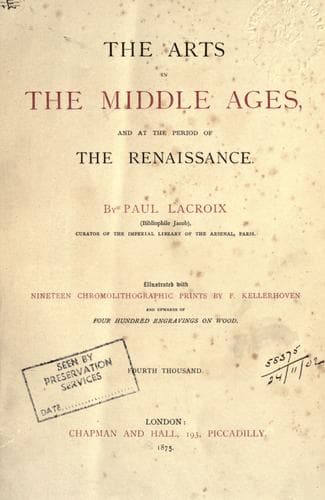
The Arts in the Middle Ages and at the Period of the RenaissanceJacob, P. L.
History
The Arts in the Middle Ages and at the Period of the Renaissance
Jacob, P. L.
Art, Medieval; Art, Renaissance; Middle Ages
Yet no single specimen, or even a drawing, of this remarkable artillery
has been handed down to us. The Museum of Artillery does, indeed,
possess one small piece, on which, between the trunnions and the breech,
is this inscription:--“Presented by Charles VIII. to Bartemi, Lord of
Pins, captain of the bands of artillery, in 1490.” This cannon presents
nothing remarkable in its construction, for we already recognise the
form, one that has scarcely varied since then, and which, it seems, was
definitely adopted under Louis XII. and Francis I. Of this period we
still have two magnificent bronze cannons. They were found at Algiers in
1830; the porcupine, the salamander, and the fleur-de-lys that ornament
them, made their origin known.
Artillery, which in the reign of Charles VIII. had become an important
arm, and had, besides, the prestige of success in Italy, became a
subject to which particular attention was given in succeeding reigns.
But, we again say, the true principles of manufacture and mounting were
already well ascertained, and only improvements in matters of detail
remained to be discovered.
The Armoury Real of Madrid contains a curious _dragonneau_,[12] cast at
Liège in 1503, which figured in the siege of Santander in 1511 (Fig.
67). The carriage, consisting of a single piece of carved oak, is by its
delicacy and finish worthy of sustaining this masterpiece of
bronze-work, which presents a double interest, first as regards art, and
then on account of the rapid advance already made in firearms; for this
_dragonneau_ has a double barrel, and is loaded at the breech.
[Illustration: Fig. 67.--Double-barrelled Dragonneau. Armoury Real of
Madrid.]
Having arrived at this point, let us again retrace our steps, in order
to note, and rapidly follow from its origin, the progress of firearms.
The earliest of these used in the middle of the fourteenth century were
called hand-cannon, and were merely formed of an iron tube pierced with
a vent, without stock or lock.
A manuscript of that period represents a warrior who, standing on one of
those little movable towers then forming part of the siege _matériel_,
is shooting a stone with a gun of this description. The piece is resting
on the parapet. By the side a sling is placed with its stone--a
circumstance which indicates the relative power of the hand-cannon, as
no doubt each engine was to be used alternately. In another place is a
horseman holding a small gun with a prolongation; the muzzle is
supported by a prong fixed on the pommel of the saddle. Thus it was
impossible for him to take aim, and he applied the fire with his hand.
A little later, to prevent the effect of the recoil, there was added
below the barrel, a little short of the centre, a sort of hook, intended
to serve the purpose of checking the piece. When fired, it was supported
on a fork or on a wall; hence the name of _arquebuse à croc_, which took
the place of that of _canon à main_.
Public-domain text, read in full here on John Shaqi.
Reviews
Reviews
No reviews yet
Be the first to share your thoughts on this work.
Elsewhere in the archive
Join the Discussion
Join the discussion
Sign in to leave a comment or review.
Sign InorCreate an account