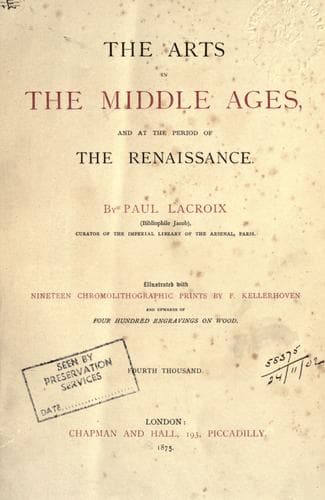
The Arts in the Middle Ages and at the Period of the RenaissanceJacob, P. L.
History
The Arts in the Middle Ages and at the Period of the Renaissance
Jacob, P. L.
Art, Medieval; Art, Renaissance; Middle Ages
[Illustration: Fig. 68.--Arquebusier. Drawn and Engraved by J. Amman.]
The _arquebuse à croc_ sometimes weighed from fifty to sixty pounds,
measured from five to six feet in length, and in principle was chiefly
adapted for firing from a wall; it was lightened a little that it might
be used by foot-soldiers, who, however, never fired it without a fixed
or a movable rest.
The inconvenience of applying fire with the hand, which, moreover,
prevented the right direction of the missile, was soon partially
superseded by adapting to the barrel a stock to fire from the shoulder,
and a lock for a match, called a _serpentin_, which had only to be let
down to ignite the powder at the touch-hole. This was the matchlock
arquebus still used by certain Eastern nations in our time, and which
secured victory to the Spaniards at the battle of Pavia.
Although the matchlock arquebus, which was made lighter, and was then
called _mousquet_, continued to be the usual arm of infantry until the
time of Louis XIII., many serious objections to the use of the
_serpentin_ continued. It compelled the soldier always to have a lighted
match, or some means of striking a light. Besides, for nearly each shot
it was necessary so to regulate the match that the end of it, which was
placed in the head of the _serpentin_ (lock), should come exactly into
the priming-pan; then the priming-pan had to be opened; these operations
were, so to speak, impossible for mounted men, who at the same time had
to manage their horses.
[Illustration: Fig. 69.--Arquebus with Wheel and Match.]
About 1517 the Germans invented the screw-plate called _à
rouet_,--wheel-lock (Fig. 69).
To the Spaniards is due the merit of the improvement that followed, the
type of which is still in a measure perpetuated in our percussion guns;
which, in their turn, have just been replaced by the needle-gun. The
Spanish screw-plate, often called the _miquelet_ screw-plate, had on the
outside a spring, which pressed, at the extremity of its movable limb,
on one of the catches of the hammer; when the gun was cocked the other
catch pressed against a pin which projected from the inside and
traversed the screw-plate; this pin could be removed, and then the
spring acted on the hammer, which was no longer held back; the flint
(for at that time a flint was fitted to the gun) struck upon a ribbed
plate of steel forming part of the cover of the priming-pan, the action
of the flint on the plate produced the fire.
Among the arms in use during the sixteenth century was one called
_petrinal_ or _poitrinal_ (petronel), on account of the bent stock,
which rested on the chest. This short and heavy arquebus, which could
only throw balls, but of a very large size, to a short distance, was
usually suspended from the shoulder by a strap or a broad cross-belt.
Public-domain text, read in full here on John Shaqi.
Reviews
Reviews
No reviews yet
Be the first to share your thoughts on this work.
Elsewhere in the archive
Join the Discussion
Join the discussion
Sign in to leave a comment or review.
Sign InorCreate an account