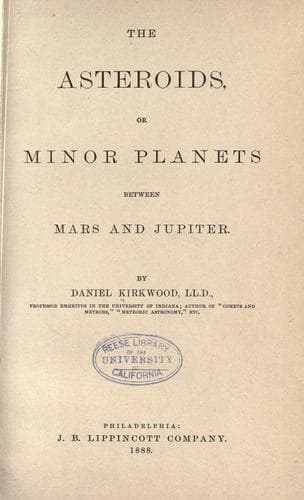
The Asteroids; Or Minor Planets Between Mars and Jupiter. — John Shaqi
The Asteroids; Or Minor Planets Between Mars and Jupiter.Kirkwood, Daniel
Science
The Asteroids; Or Minor Planets Between Mars and Jupiter.
Kirkwood, Daniel
Asteroids
When we say that an asteroid's period is commensurable with that of
Jupiter, we mean that a certain whole number of the former is equal to
another whole number of the latter. For instance, if a minor planet
completes two revolutions to Jupiter's one, or five to Jupiter's two,
the periods are commensurable. It must be remarked, however, that
Jupiter's effectiveness in disturbing the motion of a minor planet
depends on the _order_ of commensurability. Thus, if the ratio of the
less to the greater period is expressed by the fraction 1/2, where the
difference between the numerator and the denominator is one, the
commensurability is of the first order; 1/3 is of the second; 2/5, of
the third, etc. The difference between the terms of the ratio indicates
the frequency of conjunctions while Jupiter is completing the number
of revolutions expressed by the numerator. The distance 3.277,
corresponding to the ratio 1/2, is the only case of the first order in
the entire ring; those of the second order, answering to 1/3 and 3/5,
are 2.50 and 3.70. These orders of commensurability may be thus arranged
in a tabular form, the radius of the earth's orbit being the unit of
distance:
+--------+----------------+-----------+
| Order. | Ratio. | Distance. |
+--------+----------------+-----------+
| First | 1/2 | 3.277 |
| | | |
| Second | 1/3, 3/5 | { 2.50 |
| | | { 3.70 |
| | | |
| | | { 2.82 |
| Third | 2/5, 4/7, 5/8 | { 3.58 |
| | | { 3.80 |
| | | |
| | | { 2.95 |
| Fourth | 3/7, 5/9, 7/11 | { 3.51 |
| | | { 3.85 |
+--------+----------------+-----------+
Do these parts of the ring present discontinuities? and, if so, can they
be ascribed to a chance distribution? Let us consider them in order.
I.--The Distance 3.277.
At this distance an asteroid's conjunctions with Jupiter would all occur
at the same place, and its perturbations would be there repeated at
intervals equal to Jupiter's period (11.86 y.). Now, when the asteroids
are arranged in the order of their mean distances (as in Table II.) this
part of the zone presents a wide chasm. The space between 3.218 and
3.376 remains, hitherto a perfect blank, while the adjacent portions of
equal breadth, interior and exterior, contain fifty-four minor planets.
The probability that this distribution is not the result of chance is
more than three hundred billions to one.
The breadth of this chasm is one-twentieth part of its distance from the
sun, or one-eleventh part of the breadth of the entire zone.
II.--The Second Order of Commensurability.--The Distances 2.50 and 3.70.
Public-domain text, read in full here on John Shaqi.
Reviews
Reviews
No reviews yet
Be the first to share your thoughts on this work.
Join the Discussion
Join the discussion
Sign in to leave a comment or review.
Sign InorCreate an account