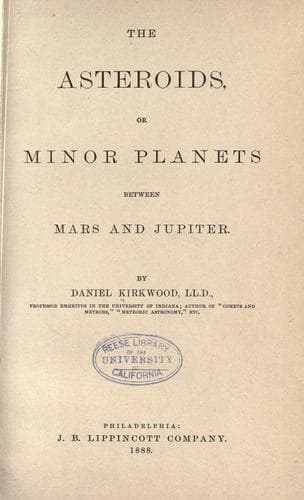
The Asteroids; Or Minor Planets Between Mars and Jupiter.Kirkwood, Daniel
Science
The Asteroids; Or Minor Planets Between Mars and Jupiter.
Kirkwood, Daniel
Asteroids
Did comets originate within the solar system, or do they enter it from
without? Laplace assigned them an extraneous origin, and his view is
adopted by many eminent astronomers. With all due respect to the
authority of great names, the present writer has not wholly abandoned
the theory that some comets of short period are specially related to the
minor planets. According to M. Lehmann-Filhès, the eccentricity of the
third comet of 1884, before its last close approach to Jupiter, was only
0.2787.[12] This is exceeded by that of twelve known minor planets. Its
mean distance before this great perturbation was about 4.61, and six of
its periods were nearly equal to five of Jupiter's,--a commensurability
of the first order. According to Hind and Krueger, the great
transformation of its orbit by Jupiter's influence occurred in May,
1875. It had previously been an asteroid too remote to be seen even in
perihelion. This body was discovered by M. Wolf, at Heidelberg,
September 17, 1884. Its present period is about six and one-half years.
The perihelion distance of the comet 1867 II. at its return in 1885 was
2.073; its aphelion is 4.897; so that its entire path, like those of the
asteroids, is included between the orbits of Mars and Jupiter. Its
eccentricity, as we have seen, is little greater than that of Æthra, and
its period, inclination, and longitude of the ascending node are
approximately the same with those of Sylvia, the eighty-seventh minor
planet. In short, this comet may be regarded as an asteroid whose
elements have been considerably modified by perturbation.
It has been stated that the gap at the distance 3.277 is the only one
corresponding to the first order of commensurability. The distance
3.9683, where an asteroid's period would be two-thirds of Jupiter's, is
immediately beyond the outer limit of the cluster as at present known;
the mean distance of Hilda being 3.9523. The discovery of new members
beyond this limit is by no means improbable. Should a minor planet at
the mean distance 3.9683 attain an eccentricity of 0.3--and this is less
than that of eleven now known--its aphelion would be more remote than
the perihelion of Jupiter. Such an orbit might not be stable. Its form
and extent might be greatly changed after the manner of Lexell's comet.
Two well-known comets, Faye's and Denning's, have periods approximately
equal to two-thirds of Jupiter's. In like manner the periods of
D'Arrest's and Biela's comets correspond to the hiatus at 3.51, and that
of 1867 II. to that at 3.277.
Of the thirteen telescopic comets whose periods correspond to mean
distances within the asteroid zone, all have direct motion; all have
inclinations similar to those of the minor planets; and their
eccentricities are generally less than those of other known comets. Have
these facts any significance in regard to their origin?
APPENDIX.
NOTE A.
THE POSSIBLE EXISTENCE OF ASTEROIDS IN UNDISCOVERED RINGS.
Public-domain text, read in full here on John Shaqi.
Reviews
Reviews
No reviews yet
Be the first to share your thoughts on this work.
Join the Discussion
Join the discussion
Sign in to leave a comment or review.
Sign InorCreate an account