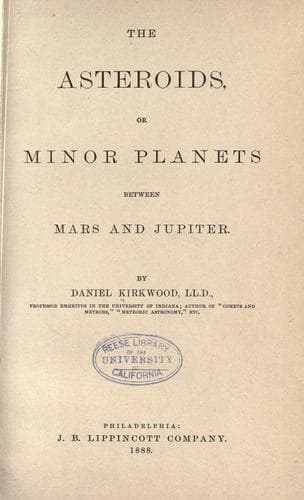
The Asteroids; Or Minor Planets Between Mars and Jupiter. — John Shaqi
The Asteroids; Or Minor Planets Between Mars and Jupiter.Kirkwood, Daniel
Science
The Asteroids; Or Minor Planets Between Mars and Jupiter.
Kirkwood, Daniel
Asteroids
If Jupiter's influence was a factor in the separation of planetules at
the sun's equator, may not similar clusters exist in other parts of our
system? The hypothesis is certainly by no means improbable. For anything
we know to the contrary a group may circulate between Jupiter and
Saturn; such bodies, however, could not be discovered--at least not by
ordinary telescopes--on account of their distance. The Zodiacal Light,
it has been suggested, may be produced by a cloud of indefinitely small
particles related to the planets between the sun and Mars. The rings of
Saturn are merely a dense asteroidal cluster; and, finally, the
phenomena of luminous meteors indicate the existence of small masses of
matter moving with different velocities in interstellar space.
NOTE B.
THE ORIGIN AND STRUCTURE OF COSMICAL RINGS.
The general theory of cosmical rings and of their arrangement in
sections or clusters with intervening chasms may be briefly stated in
the following propositions:
I.
Whenever the separating force of a primary body on a secondary or
satellite is greater than the central attraction of the latter on its
superficial stratum, the satellite, if either gaseous or liquid, will be
transformed into a ring.
EXAMPLES.--Saturn's ring, and the meteoric rings of April 20, August 10,
November 14, and November 27.
See Payne's _Sidereal Messenger_, April, 1885.
II.
When a cosmical body is surrounded by a ring of considerable breadth,
and has also exterior satellites at such distances that a simple
relation of commensurability would obtain between the periods of these
satellites and those of certain particles of the ring, the disturbing
influence of the former will produce gaps or intervals in the ring so
disturbed.
See "Meteoric Astronomy," Chapter XII.; also the _Proceedings of the
American Philosophical Society_, October 6, 1871; and the _Sidereal
Messenger_ for February, 1884; where the papers referred to assign a
physical cause for the gaps in Saturn's ring.
THE END.
FOOTNOTES:
[1] The discoverer, Piazzi, was not, as has been so often affirmed, one
of the astronomers to whom the search had been especially committed.
[2] Massalia was discovered by De Gasparis, at Naples, Sept. 19, 1852,
and independently, the next night, by Chacornac, at Marseilles. The name
was given by the latter.
[3] Astr. Nach., No. 932.
[4] Monthly Notices, vol. xxvii.
[5] Annals of the Obs. of Harv. Coll., 1879.
[6] This ingenious idea may be readily extended. The least distance of
Æthra is less than the present aphelion distance of Mars; and the
maximum aphelion distance of the latter exceeds the perihelion distance
of several known asteroids. Moreover, if we represent the orbits of the
major planets, and also those of the comets of known periods, by
material rings, it is easy to see that the major as well as the minor
planets are all linked together in the manner suggested by D'Arrest.
Public-domain text, read in full here on John Shaqi.
Reviews
Reviews
No reviews yet
Be the first to share your thoughts on this work.
Join the Discussion
Join the discussion
Sign in to leave a comment or review.
Sign InorCreate an account