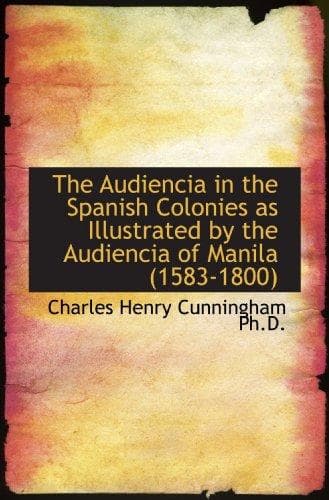
The Audiencia in the Spanish Colonies: As illustrated by the Audiencia of Manila (1583-1800)Cunningham, Charles Henry
History
The Audiencia in the Spanish Colonies: As illustrated by the Audiencia of Manila (1583-1800)
Cunningham, Charles Henry
Philippines -- History -- 1521-1812; Spain -- Colonies -- Administration
Although viceroys and governors were granted special jurisdiction over
administrative matters, they were authorized to call upon the acuerdos
[36] of the audiencias for counsel and advice whenever an exceptionally
arduous case presented itself. The audiencias were permitted to
entertain appeals against the rulings of viceroys and presidents, but
these appeals could be carried again to the Council of the Indies. In
the same manner that affairs of government belonged to the private
jurisdiction of the executive, so did financial matters, according
to Solórzano y Pereyra. In these, however, the viceroy or governor
was assisted in the solution of perplexing problems by the acuerdo
general de hacienda, a body composed of oidores, oficiales reales [37]
and contadores. On the death, disability, or absence of the viceroy or
governor and captain-general it was ordered that the government should
pass under the charge of the entire audiencia. Lastly, Solórzano y
Pereyra pointed out that while the sole duty of the Spanish oidores
was to try cases, the magistrates of the colonial audiencias were
called upon for a number of miscellaneous functions, such as those of
visitador, or inspector of the provinces, or of other departments of
the government, as asesor of the Santa Cruzada, [38] as inspector of
ships, as auditor de guerra, as asesor of the governor, and as juez
de las executorías, under commission of the Council of the Indies
to collect and remit to the government receiver all money derived
from fines and penalties imposed by official visitors (visitadores),
judges of residencia, etcetera. [39]
With the exception of the entertainment of the recurso de fuerza,
none of the above-mentioned functions could be exercised by the
audiencias of Spain. Although the colonial audiencias were to a
large extent patterned after those of Spain, they had greater
power and exercised more extensive functions almost from the
beginning. This was chiefly owing to the added responsibilities of
government resulting from the isolation of the colonies and their
distance from the home government. The audiencias in Spain remained
almost purely judicial. There was no need or opportunity for them
to encroach upon the executive, or to usurp its functions, because
of the control exercised by its immediate representatives. In the
colonies the audiencias were themselves established as the agents of
the royal authority, with the special duty of limiting the abuses
of the officials of the crown. In this capacity, aside from their
customary duties, the tribunals exercised far-reaching authority of
a non-judicial character.
Public-domain text, read in full here on John Shaqi.
The Audiencia in the Spanish Colonies: As illustrated by the Audiencia of Manila (1583-1800) — John Shaqi
Reviews
Reviews
No reviews yet
Be the first to share your thoughts on this work.
Join the Discussion
Join the discussion
Sign in to leave a comment or review.
Sign InorCreate an account