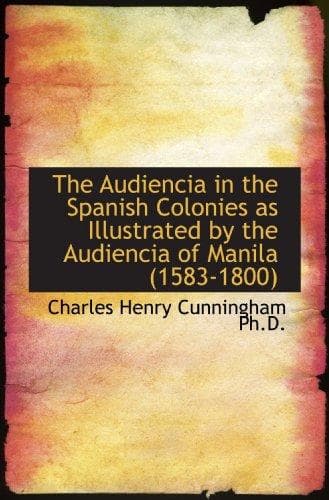
The Audiencia in the Spanish Colonies: As illustrated by the Audiencia of Manila (1583-1800)Cunningham, Charles Henry
History
The Audiencia in the Spanish Colonies: As illustrated by the Audiencia of Manila (1583-1800)
Cunningham, Charles Henry
Philippines -- History -- 1521-1812; Spain -- Colonies -- Administration
It is desirable to point out in this connection that all the
colonial audiencias utilized the same law in common. Cédulas,
edicts, and decrees were issued to them from a common source, to
be executed under similar circumstances, or on particular occasions
when local conditions demanded such action. The great code of 1680,
the Recopilación de leyes de los Reinos de las Indias, has already
been described as containing laws, both general and particular,
for the regulation of the colonial audiencias. [40]
In the foregoing paragraphs attention has been directed briefly to
the relations of the audiencias and executives with each other, and
with the central government. Some notice at least should be given
to the means by which the will of the executive and judiciary was
enforced and executed upon and in the local units, the provinces and
towns. We have already seen that the offices of the corregidores,
alcaldes mayores and the alcaldes ordinarios developed in Spain,
the first with jurisdiction over the larger districts, the alcaldes
mayores over the smaller areas and large towns, and the alcaldes
ordinarios in the municipalities. In a general sense, this system
was carried into the colonies; the corregidores and alcaldes mayores
were in charge of the large provinces and districts, the alcaldes
ordinarios were the judges of the Spanish towns.
Much the same intercourse and relations existed between these officials
in the colonies as had been characteristic of the similar ones of
Spain. But there were some differences: while in Spain the alcaldes
were in most cases city judges, subject to the corregidores, [41]
in the colonies there was little or no difference between alcaldes
mayores and corregidores. They were most frequently appointed by the
executive, sometimes independently, sometimes by the assistance and
advice of the audiencia, as judges and governors of the provinces,
although the laws of the Indies provided for their appointment
by the king. The practice developed of designating them locally,
and of sending their names to Spain for confirmation. Each alcalde
mayor or corregidor resided at the chief town of his province and
combined in himself the functions of judge, inspector of encomiendas,
administrator of hacienda and police, collector of tribute, vicepatron
and captain-general. [42] He was assisted by officials of a minor
category, frequently natives, who exercised jurisdiction over their
fellows. The law also provided for a teniente letrado to assist the
alcalde or corregidor, [43] but in the Philippines there was no such
official, except at irregular intervals in the Visayas.
Public-domain text, read in full here on John Shaqi.
Reviews
Reviews
No reviews yet
Be the first to share your thoughts on this work.
Join the Discussion
Join the discussion
Sign in to leave a comment or review.
Sign InorCreate an account