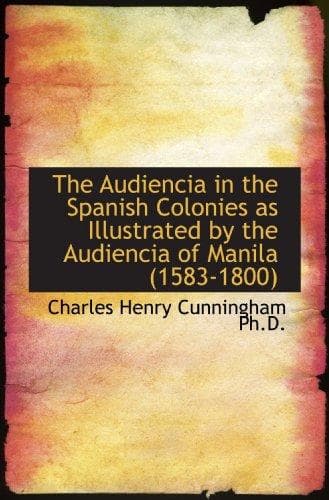
The Audiencia in the Spanish Colonies: As illustrated by the Audiencia of Manila (1583-1800) — John Shaqi
The Audiencia in the Spanish Colonies: As illustrated by the Audiencia of Manila (1583-1800)Cunningham, Charles Henry
History
The Audiencia in the Spanish Colonies: As illustrated by the Audiencia of Manila (1583-1800)
Cunningham, Charles Henry
Philippines -- History -- 1521-1812; Spain -- Colonies -- Administration
An illustration may be noted in the letter written on July 3, 1584,
by Oidor Melchoir Dávalos to the king. After several clear intimations
that he would like to be governor in case a vacancy should arise
and after modestly setting forth his own qualifications and virtues,
Dávalos wrote a faithful and vivid account of the expeditions which
had been made recently against the Mohammedan Sulus. He petitioned
for a suspension of the law forbidding slavery in order that Spaniards
might avail themselves of captive Moros as slaves. [73] He made several
recommendations in regard to the Chinese, stating particularly that he
was devoting himself to a study of the kind of government best fitted
for the Chinese in Manila. He complained that the Chinese merchants
were draining the Islands of silver, bringing as many as thirty-four
shiploads of Chinese cargo a year. Since nothing of commercial value
was produced in the Philippines, they could take away nothing else
than silver. This incessant drain on the coin imported from Acapulco
was resulting in the impoverishment of the colony and constituted a
source of danger to New Spain as well. The exportation of money was
contrary to royal orders and distinctly prejudicial to the economic
interests of the realm. Dávalos recommended immediate action in the
matter. He then discussed military affairs, alleging that the pay of
the soldiers was insufficient, and their condition miserable. The first
and third of the matters touched upon by the oidor in his memorial,
namely, the war in Mindanao and the condition of the soldiers, belonged
to the private jurisdiction of the governor and captain-general,
[74] the control of the Chinese coming later under the jurisdiction
of the governor, as captain-general, with special inhibition of the
interference of the audiencia. [75]
This letter furnishes a good illustration of the interference of an
oidor in matters of government. The desire to interfere does not
seem to have been confined to one individual, but was apparently
characteristic of all the magistrates of the audiencia. [76]
The extensive field over which the oidores claimed cognizance is
shown by a series of memorials which were sent by the audiencia as
a body to the court under the date of June 26, 1586. [77] They are
noted here because they illustrate the diversity of the interests of
the oidores, and because their devotion to these various matters was
characterized as unjustified meddling by the governor and the other
opponents of the audiencia. The concern which the oidores manifested
in the miscellaneous affairs of government constituted, no doubt,
an indirect reason for the temporary removal of the tribunal in 1589.
Public-domain text, read in full here on John Shaqi.
Reviews
Reviews
No reviews yet
Be the first to share your thoughts on this work.
Join the Discussion
Join the discussion
Sign in to leave a comment or review.
Sign InorCreate an account