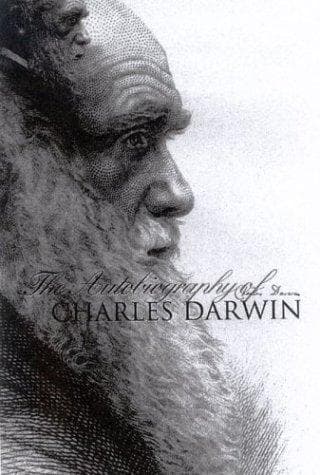
The Autobiography of Charles DarwinDarwin, Charles
Science
The Autobiography of Charles Darwin
Darwin, Charles
Darwin, Charles, 1809-1882; Darwin, Charles, 1809-1882. On the origin of species; Naturalists -- Great Britain -- Biography
On another occasion I met at Lord Stanhope’s house, one of his parties
of historians and other literary men, and amongst them were Motley and
Grote. After luncheon I walked about Chevening Park for nearly an hour
with Grote, and was much interested by his conversation and pleased by
the simplicity and absence of all pretension in his manners.
Long ago I dined occasionally with the old Earl, the father of the
historian; he was a strange man, but what little I knew of him I liked
much. He was frank, genial, and pleasant. He had strongly marked
features, with a brown complexion, and his clothes, when I saw him,
were all brown. He seemed to believe in everything which was to others
utterly incredible. He said one day to me, “Why don’t you give up your
fiddle-faddle of geology and zoology, and turn to the occult sciences!”
The historian, then Lord Mahon, seemed shocked at such a speech to me,
and his charming wife much amused.
The last man whom I will mention is Carlyle, seen by me several times
at my brother’s house, and two or three times at my own house. His talk
was very racy and interesting, just like his writings, but he sometimes
went on too long on the same subject. I remember a funny dinner at my
brother’s, where, amongst a few others, were Babbage and Lyell, both of
whom liked to talk. Carlyle, however, silenced every one by haranguing
during the whole dinner on the advantages of silence. After dinner
Babbage, in his grimmest manner, thanked Carlyle for his very
interesting lecture on silence.
Carlyle sneered at almost every one: one day in my house he called
Grote’s ‘History’ “a fetid quagmire, with nothing spiritual about it.”
I always thought, until his ‘Reminiscences’ appeared, that his sneers
were partly jokes, but this now seems rather doubtful. His expression
was that of a depressed, almost despondent yet benevolent man; and it
is notorious how heartily he laughed. I believe that his benevolence
was real, though stained by not a little jealousy. No one can doubt
about his extraordinary power of drawing pictures of things and men—far
more vivid, as it appears to me, than any drawn by Macaulay. Whether
his pictures of men were true ones is another question.
He has been all-powerful in impressing some grand moral truths on the
minds of men. On the other hand, his views about slavery were
revolting. In his eyes might was right. His mind seemed to me a very
narrow one; even if all branches of science, which he despised, are
excluded. It is astonishing to me that Kingsley should have spoken of
him as a man well fitted to advance science. He laughed to scorn the
idea that a mathematician, such as Whewell, could judge, as I
maintained he could, of Goethe’s views on light. He thought it a most
ridiculous thing that any one should care whether a glacier moved a
little quicker or a little slower, or moved at all. As far as I could
judge, I never met a man with a mind so ill adapted for scientific
research.
Public-domain text, read in full here on John Shaqi.
Reviews
Reviews
No reviews yet
Be the first to share your thoughts on this work.
Join the Discussion
Join the discussion
Sign in to leave a comment or review.
Sign InorCreate an account