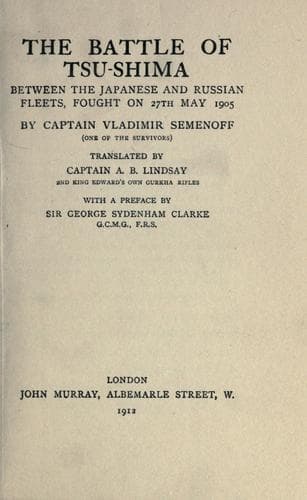
The Battle of Tsu-shima: between the Japanese and Russian fleets, fought on 27th May 1905 — John Shaqi
The Battle of Tsu-shima: between the Japanese and Russian fleets, fought on 27th May 1905Semenov, V. I. (Vladimir Ivanovich)
History
The Battle of Tsu-shima: between the Japanese and Russian fleets, fought on 27th May 1905
Semenov, V. I. (Vladimir Ivanovich)
Russo-Japanese War, 1904-1905 -- Naval operations; Tsushima, Battle of, 1905
This disposition of the fleet would make it possible, if the enemy
appeared unexpectedly, for the various squadrons to take order of
battle quickly and without any complicated manœuvres (_i.e._ without
attracting attention). The scout division was to turn from whichever
side the enemy appeared and to join the cruisers, which were to convoy
the transports out of action, and protect them from the enemy’s
cruisers. The 1st and 2nd armoured squadrons were to increase speed,
and, having inclined to port _together_,[5] were to take station in
front of the 3rd armoured squadron and proceed on their former course.
The result would be that the three squadrons would then be in single
column line ahead, and the centre of our fleet would consist of twelve
armoured ships. The _Zemtchug_ and _Izumrud_ were to manœuvre according
to circumstances and, taking advantage of their speed, together with
the torpedo-boats assigned to them, were to take station ahead, astern,
or abeam of the armoured ships. They were to be on the further side of
the fleet from the enemy, out of the range of his shells; their duty
being to prevent the enemy’s torpedo-boats from getting round the fleet.
Above was the plan of battle, worked out beforehand and known to every
officer in the fleet. The various details as to formations dependent on
the direction in which the enemy appeared, the instructions for fire
control, the manner in which assistance was to be rendered to injured
ships, the transfer of the Admiral’s flag from one ship to another,
the handing over of the command, etc., etc., were laid down in special
orders issued by the Commander-in-Chief, but these details would
scarcely be of interest to readers unacquainted with naval matters.
The day (25th May) passed quietly. Towards evening it was reported
that an accident had happened to the _Senyavin’s_ engines, and all
that night we steamed slowly. In the ward-room of the _Suvoroff_ the
officers grumbled and swore at the “old tubs,”[6] as they nicknamed
Nebogatoff’s ships, but, although natural, it was hardly fair, for we
ourselves were little better. The prolonged voyage had been a long
mournful indictment of our boilers and machinery, while our martyrs of
engineers had literally had to “get oil out of flints,” and to effect
repairs although with no material at hand with which to make them.
That night, the first cold one after six months in the tropics, we
slept splendidly, but, of course, by watches, _i.e._ half the night one
half of the officers and crew were at the guns, and the other half the
remainder.
On 26th May the clouds began to break and the sun shone fitfully, but
although a fairly fresh south-westerly breeze had sprung up, a thick
mist still lay upon the water.
Public-domain text, read in full here on John Shaqi.
Reviews
Reviews
No reviews yet
Be the first to share your thoughts on this work.
Join the Discussion
Join the discussion
Sign in to leave a comment or review.
Sign InorCreate an account