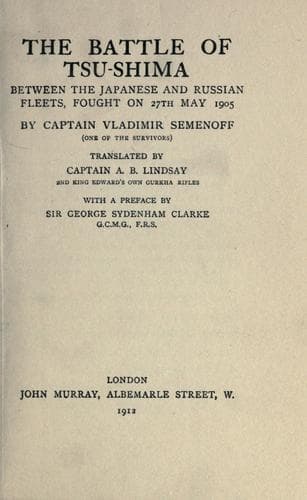
The Battle of Tsu-shima: between the Japanese and Russian fleets, fought on 27th May 1905Semenov, V. I. (Vladimir Ivanovich)
History
The Battle of Tsu-shima: between the Japanese and Russian fleets, fought on 27th May 1905
Semenov, V. I. (Vladimir Ivanovich)
Russo-Japanese War, 1904-1905 -- Naval operations; Tsushima, Battle of, 1905
Being anxious to avail himself of every moment of daylight while
passing the Japanese coast, where we would most probably be attacked
by torpedoes, the Admiral arranged for the fleet to be in the centre of
its passage through the straits of Tsu-shima at noon on the 27th May.
According to our calculations this would give us about four hours to
spare, which we employed in practising manœuvres for the last time.
Once again, and for the _last_ time, we were forcibly reminded of the
old truism that a “fleet” is created by long years of practice at
sea in time of peace (cruising, not remaining in port), and, that a
collection of ships of various types hastily collected, which have only
learned to sail together on the way to the scene of operations, is no
fleet, but a chance concourse of vessels.
Taking up order of battle was moderately performed, but it was spoilt
by the 3rd squadron, and who can blame its admiral or captains? When
near Madagascar, and during our wanderings off the coast of Annam, our
ships to a certain extent had been able to learn their work, and to get
to know one another. They had, in fact, been able to “rehearse.” But as
the 3rd squadron, which joined the fleet barely a fortnight ago,[7] had
only arrived in time to finish the voyage with us and take part in the
battle, there was no time for it to receive instruction.
Admiral Togo, on the other hand, had commanded his squadron
continuously for eight years without hauling down his flag. Five of
the vice-admirals and seven of the rear-admirals taking part in the
Tsu-shima battle, in command of squadrons, ships, or as junior flag
officers, were his old comrades and pupils, having been educated under
his command. As for us, we could only regret our unpreparedness, and in
the coming fight there was nothing for us to do but to make the most of
what we had.
Rozhdestvensky thought (and facts later fully justified the opinion)
that in the decisive battle Togo would be at the head of his twelve
best armoured ships. Against them our Admiral was also to lead twelve
similar ships (which he handled magnificently), and in the duel between
them it was thought the centre of gravity of the fight would certainly
lie. The difference between our main force and that of the Japanese
was very material. The oldest of Togo’s twelve ships--the _Fuji_, was
two years younger than the _Sissoy_, which, among our twelve best, came
sixth in seniority! Their speed was one-and-a-half times as great as
ours, but their chief superiority lay in their new shells, of which we
had no inkling.
What with manœuvres, etc., the 26th May passed almost imperceptibly.
Public-domain text, read in full here on John Shaqi.
Reviews
Reviews
No reviews yet
Be the first to share your thoughts on this work.
Join the Discussion
Join the discussion
Sign in to leave a comment or review.
Sign InorCreate an account