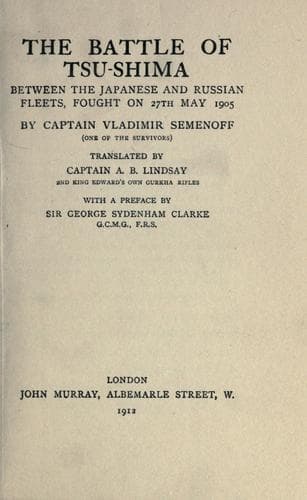
The Battle of Tsu-shima: between the Japanese and Russian fleets, fought on 27th May 1905Semenov, V. I. (Vladimir Ivanovich)
History
The Battle of Tsu-shima: between the Japanese and Russian fleets, fought on 27th May 1905
Semenov, V. I. (Vladimir Ivanovich)
Russo-Japanese War, 1904-1905 -- Naval operations; Tsushima, Battle of, 1905
In all wars, whether by sea or land, some few general lessons stand out
unmistakably; but the difficulty of arriving at a just estimate of the
relative significance of the causes which have led to victory or to
defeat is always extreme. Genius, which may be defined as an unerring
sense of proportion, is necessarily rare, and the person with an _idée
fixe_ in favour of some particular method or weapon will generally
discover, in every conflict, evidence in support of his faith. This
tendency will be most marked when national experience of war is
lacking, and we are, therefore, compelled to draw our inspirations from
fighting carried on by other peoples.
In the long series of wars which culminated in the Nelson era, broad
principles had been evolved and had been grasped by the leaders of
naval thought. More than ninety years have elapsed since the British
Navy was called upon to fight a great fleet action, and meanwhile
technical progress of all kinds, advancing by giant strides, has opened
out new possibilities tending to bewilder the imagination and to
invite mistakes and impolicy.
Even when, as now, valuable war experience is available, there is
always a risk of false deductions. Conditions differ so greatly that
generalisations based upon special episodes may be misleading and even
dangerous. Thus the American Navy and our own have unquestionably
suffered from shallow reasoning derived from the peculiar operations of
the Civil War. Similarly, the action off Lissa led to a cult of the ram
which has left a deep impress upon shipbuilding, while a few isolated
successes obtained by torpedoes, in exceptional circumstances, have
given rise to exaggerated claims on behalf of this weapon which can
only end in disappointment.
Instances could be multiplied, and the obvious moral is the vital
necessity for the most careful study by the clearest available brains
before translating any so-called lesson of war into national policy.
In a single year a navy of the magnitude of our own may be committed
to many millions of expenditure, the result of which will affect its
fighting efficiency for nearly a quarter of a century. The vital
need for caution and for profound study of all such experience as is
forthcoming is, therefore, evident.
The battle of Tsu-shima is by far the greatest and the most important
naval event since Trafalgar, and the navy which is able to draw the
most accurate conclusions, technical as well as tactical, from its
experiences and to apply them in terms of policy and of training will
secure marked advantage in the future.
Public-domain text, read in full here on John Shaqi.
Reviews
Reviews
No reviews yet
Be the first to share your thoughts on this work.
Join the Discussion
Join the discussion
Sign in to leave a comment or review.
Sign InorCreate an account