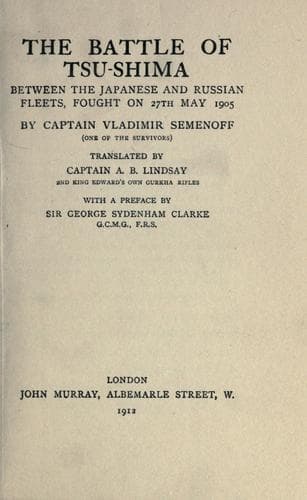
The Battle of Tsu-shima: between the Japanese and Russian fleets, fought on 27th May 1905Semenov, V. I. (Vladimir Ivanovich)
History
The Battle of Tsu-shima: between the Japanese and Russian fleets, fought on 27th May 1905
Semenov, V. I. (Vladimir Ivanovich)
Russo-Japanese War, 1904-1905 -- Naval operations; Tsushima, Battle of, 1905
At the battle of the Yalu the Japanese and Chinese fleets were
numerically equal--twelve ships--but the former had only three vessels
(all under 3000 tons) carrying side armour, and eight were protected
cruisers.[1] The Chinese, on the other hand, had five vessels with side
armour, including two battleships, and six protected cruisers.[1] In
heavy armament the Chinese had a great superiority, the Japanese having
the advantage in quick-firing guns, as shown below:
------------------------------+------+-------
GUNS. |JAPAN.| CHINA.
------------------------------+------+-------
12-inch and over | 3 | 8
Over 8-inch and under 12-inch | 8 | 17
Intermediate | 27 | 15
Q.F. 6-inch and 4.7 inch | 67 | 2
------------------------------+------+-------
At Tsu-shima the classification of armoured ships engaged was as
follows:
--------------------------+--------+--------
CLASS. | JAPAN. | RUSSIA.
--------------------------+--------+--------
Battleships | 4 | 8
Coast-defence Armour-clad | ... | 3
Armoured Cruisers | 8 | 3
+--------+--------
TOTAL, | 12 | 14
--------------------------+--------+--------
The respective armaments were:
-------+-------+-------+------+------+---------------
| | | | | Q.F.
| | | | +------+--------
GUNS. | 12-IN.| 10-IN.| 9-IN.| 8-IN.| 6-IN.| 4.7 IN.
-------+-------+-------+------+------+------+--------
Japan | 16 | 1 | ... | 30 | 160 | ...
Russia | 26 | 15 | 4 | 8 | 102 | 30
-------+-------+-------+------+------+------+--------
In heavy guns (9-inch and over) the Russians had the large
preponderance of 28, the proportion being 45 to 17. In the smaller
types, 4.7-inch to 8-inch, on the other hand, the Japanese superiority
was 50, and in the 6-inch Q.F. type alone it was 58. A fair inference
seems to be that the Japanese secondary armaments played the most
important part in the first and practically decisive period of the
battle.
In both actions the Japanese had the highest average speed--about 2
knots at the battle of the Yalu and much more at Tsu-shima, where the
three Russian coast-defence ships, the older battleships, and the three
armoured cruisers were poor steamers. Excluding, on the Russian side,
the _Sissoy-Veliki_, _Navarin_, and _Nicolay I._, the difference of
average battleship speed was only 0.6 knots; but the condition of the
Russian vessels was such that they could not approach their theoretical
maximum.
Public-domain text, read in full here on John Shaqi.
Reviews
Reviews
No reviews yet
Be the first to share your thoughts on this work.
Join the Discussion
Join the discussion
Sign in to leave a comment or review.
Sign InorCreate an account