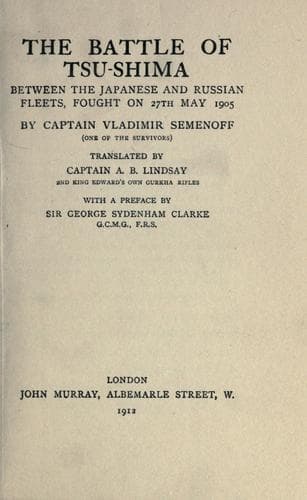
The Battle of Tsu-shima: between the Japanese and Russian fleets, fought on 27th May 1905Semenov, V. I. (Vladimir Ivanovich)
History
The Battle of Tsu-shima: between the Japanese and Russian fleets, fought on 27th May 1905
Semenov, V. I. (Vladimir Ivanovich)
Russo-Japanese War, 1904-1905 -- Naval operations; Tsushima, Battle of, 1905
The ward-room resounded with cheers, and their last echoes had scarcely
died away ere the alarm sounded on deck. Every one rushed to their
stations, to find that some Japanese light cruisers had again appeared
on our port bow, but this time they were accompanied by torpedo-boats,
which evidently intended to cross our bows. Suspecting that their
plan was to lay floating mines (as they had done on 10th August),
the Admiral ordered the 1st squadron to turn to starboard, so as to
drive off the enemy by threatening him with the fire of our five best
battleships.
With this intention the ships of the 1st squadron turned “in
succession” 8 points (90°) to starboard, and should afterwards have
turned “together” 8 points to port. The first half of the manœuvre
was most successfully performed, but the signal for the second was
evidently misunderstood, as the _Alexander_ followed the _Suvoroff_,
while the _Borodino_ and _Orel_, which had already commenced to turn
correctly “together,” imagining then that they were mistaken, turned
back and followed the _Alexander_. Consequently the 1st squadron
found itself in single column line ahead, parallel to the 2nd and 3rd
squadrons, but somewhat ahead of them.
This unsuccessful manœuvre, however, had a most important result. The
enemy’s cruisers and torpedo-boats, afraid of being caught between the
fire of both columns, abandoned their intention of crossing our course,
and hurriedly drew off to port. These cruisers probably also reported
to Togo that we were steaming in two columns, and he (being then out of
sight and far ahead of us on the starboard bow) decided to cross over
to our port side, so as to throw himself with all his strength upon
our port and weakest column.
As soon as the Japanese drew off, the 1st squadron at once increased
speed, inclining to port so as again to take station ahead of the 2nd
squadron.
At 1.20 P.M., when the 1st had got ahead of the 2nd and 3rd squadrons
and was steering on its former course, the flag-ship signalled, “The
2nd squadron, maintaining its formation, will take station astern of
the 1st.”
And now, far ahead of us in the distance, could be dimly seen
approaching through the mist the Japanese main force. Their ships
were crossing our bows from starboard to port, following on an almost
south-west course. The _Mikasa_, as soon as she crossed our bows, at
once altered course to the southward, followed by the _Shikishima_,
_Fuji_, Asahi, _Kasuga_, and _Nisshin_.
Meanwhile, though the flag-ship was already being worked from the
conning tower, Rozhdestvensky was still standing with his staff on the
upper fore-bridge.
I frankly confess that I did not agree with his opinion as to Togo
leading all his twelve armoured ships in column; on 10th August
he ordered six of them to work independently, instead of joining
his squadron. I was inclined to think that Kamimura would operate
independently and, when my six old Port Arthur acquaintances hove in
sight, I said triumphantly:
Public-domain text, read in full here on John Shaqi.
Reviews
Reviews
No reviews yet
Be the first to share your thoughts on this work.
Join the Discussion
Join the discussion
Sign in to leave a comment or review.
Sign InorCreate an account