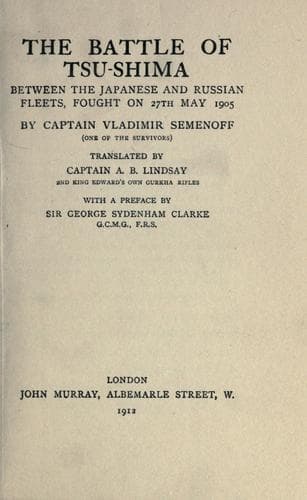
The Battle of Tsu-shima: between the Japanese and Russian fleets, fought on 27th May 1905Semenov, V. I. (Vladimir Ivanovich)
History
The Battle of Tsu-shima: between the Japanese and Russian fleets, fought on 27th May 1905
Semenov, V. I. (Vladimir Ivanovich)
Russo-Japanese War, 1904-1905 -- Naval operations; Tsushima, Battle of, 1905
“There they are, sir--_all six_--just as on 10th August.”
But Rozhdestvensky, without turning, shook his head.
“No, there are more--they are all there,” and he went down into the
conning tower.
“To your stations, gentlemen,” said the Flag Captain quickly, as he
followed the Admiral.
And there, sure enough, following after the first six ships, and slowly
appearing out of the mist, came the _Idzumo_, _Yakumo_, _Asama_,
_Adzuma_, _Tokiwa_, and _Iwate_.
CHAPTER III
“Now the fun will begin,” thought I to myself, going up to the
after-bridge, which seemed to be the most convenient place for carrying
out my duty of seeing and noting down everything, as from there I could
see both the enemy and our own fleet. Lieutenant Reydkin, commanding
the after starboard 6-inch turret, was also there, having dashed up to
see what was going on, as the fight was apparently to commence to port,
and his turret would not be in action.
We stood side by side, exchanging now and again abrupt remarks, not
understanding why the Japanese intended crossing to our port side, when
our weak spot--the transports and cruisers covering them--was astern,
and to starboard of us. Perhaps, having commenced the fight while
steering on the opposite course, and having taken advantage of their
superior speed, they calculated on rounding us from the stern, in order
to fall at the same time on our transports and weak rear! If so, a
raking fire would present no difficulties.
“Hullo! Look! What _are_ they up to?” said Reydkin, and his voice
betrayed both delight and amazement.
I looked and looked, and, not believing my eyes, could not put down
my glasses. The Japanese ships had suddenly commenced to turn “in
succession” to port, reversing their course!
If the reader recollects what has been said previously on the subject
of turns, he will easily understand that this manœuvre made it
necessary for all the enemy’s ships to pass in succession over the
point on which the leading ship had turned; this point was, so to
speak, stationary on the water, making it easy for us to range and aim.
Besides--even with a speed of 15 knots, the manœuvre must take about
fifteen minutes to complete, and all this time the vessels, which had
already turned, would mask the fire of those which were still coming up.
“_How_ rash!” said Reydkin, who could not keep quiet. “Why, in a
minute we’ll be able to roll up the leading ships!”
“Please God, we may!” thought I.
Public-domain text, read in full here on John Shaqi.
Reviews
Reviews
No reviews yet
Be the first to share your thoughts on this work.
Join the Discussion
Join the discussion
Sign in to leave a comment or review.
Sign InorCreate an account