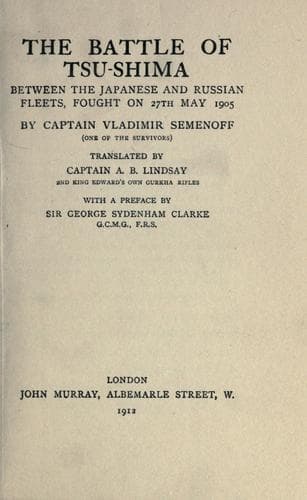
The Battle of Tsu-shima: between the Japanese and Russian fleets, fought on 27th May 1905Semenov, V. I. (Vladimir Ivanovich)
History
The Battle of Tsu-shima: between the Japanese and Russian fleets, fought on 27th May 1905
Semenov, V. I. (Vladimir Ivanovich)
Russo-Japanese War, 1904-1905 -- Naval operations; Tsushima, Battle of, 1905
The ship’s ikon or, more properly speaking, ikons as there were
several of them, all farewell gifts to the ship, were untouched. The
glass of the big ikon case had not even been broken, and in front of
it, on hanging candlesticks, candles were peacefully burning. There
wasn’t a soul to be seen. Between the wrecked tables, stools, broken
bottles, and different hospital appliances were some dead bodies, and a
mass of something, which, with difficulty, I guessed to be the remains
of what had once been men.
I had not had time properly to take in this scene of destruction when
Demchinsky came down the ladder, supporting Flag Lieutenant Sverbeyeff,
who could scarcely stand.
He was gasping for breath, and asked for water. Ladling some out of a
bucket into a mess kettle, I gave him some, and, as he was unable to
use his arms, we had to help him. He drank greedily, jerking out a few
words--“It’s a trifle--tell the Flag Captain--I’ll come immediately--I
am suffocated with these cursed gases--I’ll get my breath in a minute.”
He inhaled the air with a great effort through his blue lips, and
something seemed to rattle in his throat and chest, though not, of
course, the poisonous gases. On the right side of his back his coat was
torn in a great rent, and his wound was bleeding badly. Demchinsky told
off a couple of men to take him down to the hospital, and we again went
on deck.
I crossed over to the port side, between the forward 12-inch and 6-inch
turrets, to have a look at the enemy’s fleet. It was all there, just
the same--no fires--no heeling over--no fallen bridges, as if it had
been at drill instead of fighting, and as if our guns, which had been
thundering incessantly for the last half-hour, had been firing--not
shells, but the devil alone knows what![19]
Feeling almost in despair, I put down my glasses and went aft.
“The last of the halyards are burned,” said Demchinsky to me. “I think
I shall take my men somewhere under cover.” Of course, I fully agreed.
What was the use of the signalmen remaining under fire when nothing was
left for them to signal with!
_It was now 2.20 p.m._
Making my way aft through the _débris_, I met Reydkin hurrying to the
forecastle. “We can’t fire from the port quarter,” he said excitedly;
“everything is on fire there, and the men are suffocated with heat and
smoke.”
“Well! come on, let’s get some one to put the fire out.”
“I’ll do that, but you report to the Admiral. Perhaps he will give us
some orders.”
“What orders can he give?”
“He may alter the course. I don’t know!”
“What! leave the line? Is it likely?”
“Well! anyway, you tell him.”
In order to quiet him, I promised to report at once, and we separated,
going our ways. As I anticipated, the Admiral only shrugged his
shoulders on hearing my report and said, “They _must_ put the fire out.
No help can be sent from here.”
Public-domain text, read in full here on John Shaqi.
Reviews
Reviews
No reviews yet
Be the first to share your thoughts on this work.
Join the Discussion
Join the discussion
Sign in to leave a comment or review.
Sign InorCreate an account