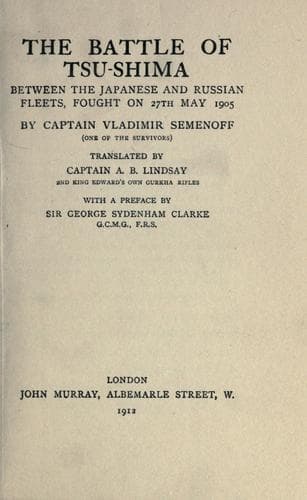
The Battle of Tsu-shima: between the Japanese and Russian fleets, fought on 27th May 1905 — John Shaqi
The Battle of Tsu-shima: between the Japanese and Russian fleets, fought on 27th May 1905Semenov, V. I. (Vladimir Ivanovich)
History
The Battle of Tsu-shima: between the Japanese and Russian fleets, fought on 27th May 1905
Semenov, V. I. (Vladimir Ivanovich)
Russo-Japanese War, 1904-1905 -- Naval operations; Tsushima, Battle of, 1905
Instead of two dead bodies, five or six were now lying in the conning
tower. The man at the wheel having been incapacitated, Vladimirsky had
taken his place. His face was covered with blood, but his moustache was
smartly twisted upwards, and he wore the same self-confident look as
he had in the ward-room when discussing “the future of gunnery.”
Leaving the tower, I intended going to Reydkin to tell him the
Admiral’s reply and to assist in extinguishing the fire, but instead I
remained on the bridge looking at the Japanese fleet.
CHAPTER IV
After steering on their new course for a quarter of an hour, the enemy
had again forged a considerable distance ahead, and now the _Mikasa_,
at the head of the column, gradually inclined to starboard to cross
our T. I waited for us to incline to starboard also, but the Admiral
held on to the old course for some time longer. I guessed that by doing
this he hoped to lessen the distance as much as possible, which would
naturally have assisted us, since, with our wrecked range-finders and
gun-directing positions, our guns were only serviceable at close
quarters. However, to allow the enemy to cross our T and to subject
ourselves to a raking fire was not to be thought of. Counting the
moments anxiously I watched and waited. The _Mikasa_ came closer and
closer to our course. Our 6-inch starboard turret was already preparing
to fire, when--we sharply inclined to starboard. Breathing freely
again, I looked around.
Demchinsky had not yet gone below with his men but was hard at work,
apparently moving the cartridge boxes of the 47-millimetre guns off
the deck into the turret, so that there should be less risk of their
exploding in the fire and causing greater damage. I went to ask him
what he was doing, but before I was able to say anything the Captain
appeared at the top of the ladder just behind me. His head was covered
with blood and, staggering convulsively, he clutched at the hand-rail.
At that moment a shell burst quite close to us and, losing his balance
from the sudden explosion, he fell, head foremost, down the ladder.
Luckily we saw it and were able to catch him.
“It’s nothing--only a trifle,” he said in his ordinary quick way of
speaking. He tried to force a smile and, jumping up, endeavoured to go
on. But as to go on to the hospital meant another three ladders, we put
him, in spite of his protests, on a stretcher.
A man reported that the after turret had been blown up[20] and almost
simultaneously there resounded above us a rumbling noise accompanied
by the sharp clank of falling iron. Something large and heavy fell
with a crash; the ship’s boats on the spar-deck were smashed to
bits; burning _débris_ fell all round us and we were enveloped in an
impenetrable smoke. At the time we did not know what had happened, but
afterwards we learned that it was the foremost funnel which had fallen.
Public-domain text, read in full here on John Shaqi.
Reviews
Reviews
No reviews yet
Be the first to share your thoughts on this work.
Join the Discussion
Join the discussion
Sign in to leave a comment or review.
Sign InorCreate an account