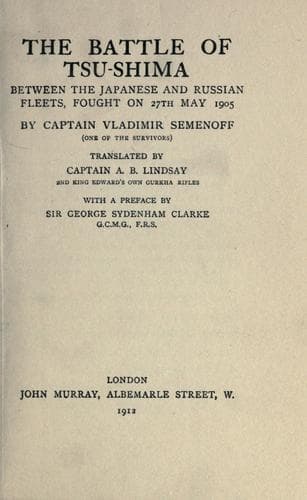
The Battle of Tsu-shima: between the Japanese and Russian fleets, fought on 27th May 1905 — John Shaqi
The Battle of Tsu-shima: between the Japanese and Russian fleets, fought on 27th May 1905Semenov, V. I. (Vladimir Ivanovich)
History
The Battle of Tsu-shima: between the Japanese and Russian fleets, fought on 27th May 1905
Semenov, V. I. (Vladimir Ivanovich)
Russo-Japanese War, 1904-1905 -- Naval operations; Tsushima, Battle of, 1905
The following account of the battle of Tsu-shima, fought on 27th May
1905, is a translation of the narrative of Captain Vladimir Semenoff, a
Russian naval officer who was on board the flag-ship (_Knyaz Suvoroff_)
during the engagement. It is of more than usual interest, as the writer
had previously served in the _Cesarevitch_ at Port Arthur, and had
taken part in the disastrous sally from that port on 10th August 1904.
At the great battle of which he now relates his experiences, he
was present in an unofficial capacity, which gave him unlimited
opportunity for observation. Moreover, the fact of his being able to
make a series of notes at the time (till too seriously wounded) puts an
additional stamp of reality on to his already most graphic account.
It should be remembered that the Russian Baltic fleet--Russia’s final
and supreme appeal to the God of Battles--left Cronstadt for the Far
East on 11th September 1904, and during all the long months till the
following May was slowly making its way, _viâ_ the Cape of Good Hope,
to Japanese waters. The difficulties encountered during that prolonged
voyage were enormous. The nerves of officers and men, who constantly
apprehended attempts to destroy the fleet, were in a continual state
of tension: news of the outside world and especially of events in
the Far East was practically unobtainable: and yet officers and men,
despite the additional disadvantage of having to take their ships into
action after these many months at sea, fearlessly entered into an
engagement which they knew meant death, and fought their ships with a
self-devotion and courage which has earned for them the admiration of
the world.
Admiral Togo--flying his flag on the _Mikasa_--awaited the enemy in
Japanese waters. His fleet, which, since the fall of Port Arthur on 2nd
January 1905, had been relieved of its blockading duties, had spent the
intervening months in repairing damage and bringing itself up to the
highest state of preparation in expectation of the coming of the Baltic
fleet.
To a nation like ourselves, whose first line of defence is the Navy,
I venture to think that these pages will give food for thought, as,
besides enabling the reader to see the paralysing and awful effect of
high explosives thrown on board a modern battleship in action, they
supply us with a picture of what a losing engagement means to those who
lose.
When first I took up the original volume I read it merely with a
view to extracting information _re_ fire effect, gun power, weather
conditions, formations, and other factors complementary to the result
of the battle. But the narrative appeared so realistic that the thought
occurred to me to place the following translation before the public.
Public-domain text, read in full here on John Shaqi.
Reviews
Reviews
No reviews yet
Be the first to share your thoughts on this work.
Join the Discussion
Join the discussion
Sign in to leave a comment or review.
Sign InorCreate an account