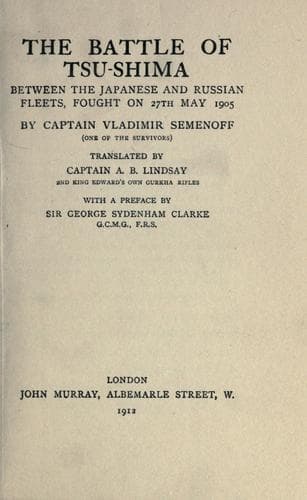
The Battle of Tsu-shima: between the Japanese and Russian fleets, fought on 27th May 1905 — John Shaqi
The Battle of Tsu-shima: between the Japanese and Russian fleets, fought on 27th May 1905Semenov, V. I. (Vladimir Ivanovich)
History
The Battle of Tsu-shima: between the Japanese and Russian fleets, fought on 27th May 1905
Semenov, V. I. (Vladimir Ivanovich)
Russo-Japanese War, 1904-1905 -- Naval operations; Tsushima, Battle of, 1905
Such was the _Suvoroff_, which was driven out of the line in less than
forty minutes, and after being reduced to the hopeless state described
by Captain Semenoff, was gratuitously torpedoed by the Japanese. Being
the flag-ship of the Commander-in-Chief she was doubtless singled out
as a target; but, of her three sister-ships, the _Alexander III._ was
sunk by gun fire about five hours after the beginning of the action;
the _Borodino_ also sank in five hours, apparently as the result of the
explosion of a magazine; and the _Orel_ surrendered on the 28th with
main turrets not seriously injured and thick armour not penetrated.
The general impression conveyed by Captain Semenoff, and confirmed
from other sources, is that the Russian ships were overwhelmed by the
volume of the Japanese fire, and that frequency of hitting rather
than weight of shells should be the main object. If this conclusion
is correct, the principle which guided the British Navy in the days
of Nelson--to close to effective range and then deliver the most
rapid fire possible--has been strikingly reaffirmed. Effective ranges
have increased; but this principle remains unchanged and is probably
unchangeable.
The trouble which arose from the outbreak of fire on board the
_Suvoroff_ and from the wreckage of the bridges and spar-deck, the
men killed in the conning tower, the penetration of the armoured deck
near the bow, the down-draught of smoke, the estimate of range (“a
little more than 20 cables”) at a critical moment--all these points,
which present themselves in the narrative, claim attention and careful
comparison with other accounts.
Captain Semenoff’s impressions of the manœuvring of the fleets
may well be somewhat vague; but it is worth collating with other
observations. Lastly, the graphic touches of the author show with
painful distinctness the terrible strain imposed upon human endurance.
Few who read his account of the heroic signalmen “standing silently
and outwardly calm,” unwilling to go below the armoured deck, wishing
only for orders, and feeling “themselves indispensable to the fight,”
will be inclined to accept the recent theory that partly-trained and
half-disciplined men are fit to find a place on board ship in modern
naval war.
Upon a correct understanding of the lessons of Tsu-shima the
expenditure of millions of public money and the efficiency of the Navy
in the near future must mainly depend. If this simple narrative can,
in however small a degree, help us to attain such an understanding, its
publication will be abundantly justified.
G. S. CLARKE.
LONDON, _10th November 1906_.
TRANSLATOR’S PREFACE
Public-domain text, read in full here on John Shaqi.
Reviews
Reviews
No reviews yet
Be the first to share your thoughts on this work.
Join the Discussion
Join the discussion
Sign in to leave a comment or review.
Sign InorCreate an account