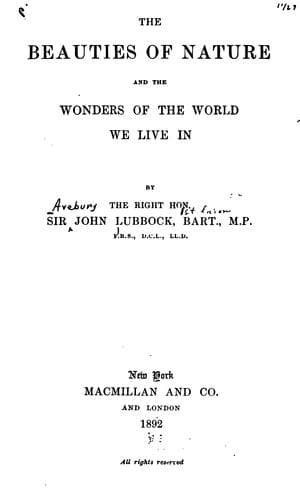
The Beauties of Nature, and the Wonders of the World We Live InLubbock, John, Sir
Philosophy
The Beauties of Nature, and the Wonders of the World We Live In
Lubbock, John, Sir
Astronomy; Natural history; Physical geography
It is generally considered that death is the common lot of all living
beings. But is this necessarily so? Infusoria and other unicellular
animals multiply by division. That is to say, if we watch one for a
certain time, we shall observe, as already mentioned, that a
constriction takes place, which grows gradually deeper and deeper, until
at last the two halves become quite detached, and each swims away
independently. The process is repeated over and over again, and in this
manner the species is propagated. Here obviously there is no birth and
no death. Such creatures may be killed, but they have no natural term of
life. They are, in fact, theoretically immortal. Those which lived
millions of years ago may have gone on dividing and subdividing, and in
this sense multitudes of the lower animals are millions of years old.
FOOTNOTES:
[15] Address to Microscopical Society, 1890.
[16] _Ants, Bees, and Wasps_, and _The Senses of Animals_.
[17] Prof. Drummond (_Tropical Africa_) dwells with great force on the
manner in which the soil of Central Africa is worked up by the White
Ants.
[18] Lankester, _Comparative Longevity_. See also Weismann, _Duration of
Life_.
CHAPTER IV
ON PLANT LIFE
Flower in the crannied wall,
I pluck you out of the crannies,
I hold you here, root and all, in my hand,
Little flower--but _if_ I could understand
What you are, root and all, and all in all,
I should know what God and man is.
TENNYSON.
CHAPTER IV
ON PLANT LIFE
We are told that in old days the Fairies used to give presents of
Flowers and Leaves to those whom they wished to reward, or whom they
loved best; and though these gifts were, it appears, often received with
disappointment, still it will probably be admitted that flowers have
contributed more to the happiness of our lives than either gold or
silver or precious stones; and that our happiest days have been spent
out-of-doors in the woods and fields, when we have
... found in every woodland way
The sunlight tint of Fairy Gold.[19]
To many minds Flowers acquired an additional interest when it was shown
that there was a reason for their colour, size, and form--in fact, for
every detail of their organisation. If we did but know all that the
smallest flower could tell us, we should have solved some of the
greatest mysteries of Nature. But we cannot hope to succeed--even if we
had the genius of Plato or Aristotle--without careful, patient, and
reverent study. From such an inquiry we may hope much; already we have
glimpses, enough to convince us that the whole history will open out to
us conceptions of the Universe wider and grander than any which the
Imagination alone would ever have suggested.
Public-domain text, read in full here on John Shaqi.
Reviews
Reviews
No reviews yet
Be the first to share your thoughts on this work.
Join the Discussion
Join the discussion
Sign in to leave a comment or review.
Sign InorCreate an account