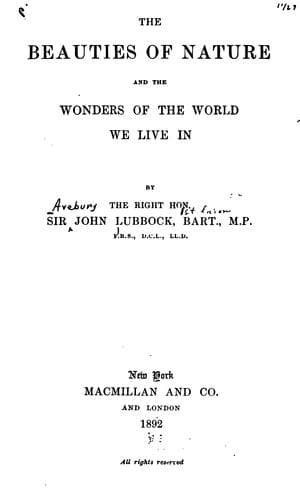
The Beauties of Nature, and the Wonders of the World We Live InLubbock, John, Sir
Philosophy
The Beauties of Nature, and the Wonders of the World We Live In
Lubbock, John, Sir
Astronomy; Natural history; Physical geography
Attempts to explain the forms, colours, and other characteristics of
animals and plants are by no means new. Our Teutonic forefathers had a
pretty story which explained certain points about several common plants.
Balder, the God of Mirth and Merriment, was, characteristically enough,
regarded as deficient in the possession of immortality. The other
divinities, fearing to lose him, petitioned Thor to make him immortal,
and the prayer was granted on condition that every animal and plant
would swear not to injure him. To secure this object, Nanna, Balder's
wife, descended upon the earth. Loki, the God of Envy, followed her,
disguised as a crow (which at that time were white), and settled on a
little blue flower, hoping to cover it up, so that Nanna might overlook
it. The flower, however, cried out "forget-me-not, forget-me-not," and
has ever since been known under that name. Loki then flew up into an oak
and sat on a mistletoe. Here he was more successful. Nanna carried off
the oath of the oak, but overlooked the mistletoe. She thought, however,
and the divinities thought, that she had successfully accomplished her
mission, and that Balder had received the gift of immortality.
One day, supposing Balder proof, they amused themselves by shooting at
him, posting him against a Holly. Loki tipped an arrow with a piece of
Mistletoe, against which Balder was not proof, and gave it to Balder's
brother. This, unfortunately, pierced him to the heart, and he fell
dead. Some drops of his blood spurted on to the Holly, which accounts
for the redness of the berries; the Mistletoe was so grieved that she
has ever since borne fruit like tears; and the crow, whose form Loki had
taken, and which till then had been white, was turned black.
This pretty myth accounts for several things, but is open to fatal
objections.
Recent attempts to explain the facts of Nature are not less fascinating,
and, I think, more successful.
Why then this marvellous variety? this inexhaustible treasury of
beautiful forms? Does it result from some innate tendency in each
species? Is it intentionally designed to delight the eye of man? Or has
the form and size and texture some reference to the structure and
organisation, the habits and requirements of the whole plant?
I shall never forget hearing Darwin's paper on the structure of the
Cowslip and Primrose, after which even Sir Joseph Hooker compared
himself to Peter Bell, to whom
A primrose by a river's brim
A yellow primrose was to him,
And it was nothing more.
We all, I think, shared the same feeling, and found that the explanation
of the flower then given, and to which I shall refer again, invested it
with fresh interest and even with new beauty.
Public-domain text, read in full here on John Shaqi.
Reviews
Reviews
No reviews yet
Be the first to share your thoughts on this work.
Join the Discussion
Join the discussion
Sign in to leave a comment or review.
Sign InorCreate an account