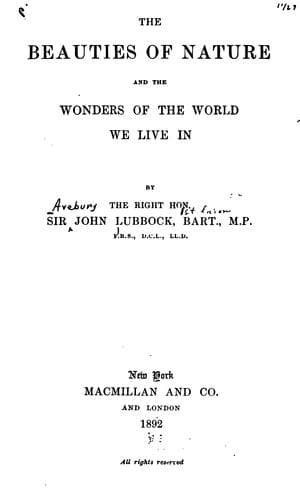
The Beauties of Nature, and the Wonders of the World We Live InLubbock, John, Sir
Philosophy
The Beauties of Nature, and the Wonders of the World We Live In
Lubbock, John, Sir
Astronomy; Natural history; Physical geography
As oft as thou puttest thy hand therein
A mark of gold thou shalt iwinne,
as well as protection from the main dangers of life. Such times have
passed away, but better ones have come. It is not now merely the few,
who are so favoured. All those who love Nature she loves in return, and
will richly reward, not perhaps with the good things, as they are
commonly called, but with the best things, of this world; not with money
and titles, horses and carriages, but with bright and happy thoughts,
contentment and peace of mind.
Happy indeed is the naturalist: to him the seasons come round like old
friends; to him the birds sing: as he walks along, the flowers stretch
out from the hedges, or look up from the ground, and as each year fades
away, he looks back on a fresh store of happy memories.
Though we can never "remount the river of our years," he who loves
Nature is always young. But what is the love of Nature? Some seem to
think they show a love of flowers by gathering them. How often one finds
a bunch of withered blossoms on the roadside, plucked only to be thrown
away! Is this love of Nature? It is, on the contrary, a wicked waste,
for a waste of beauty is almost the worst waste of all.
If we could imagine a day prolonged for a lifetime, or nearly so, and
that sunrise and sunset were rare events which happened but a few times
to each of us, we should certainly be entranced by the beauty of the
morning and evening tints. The golden rays of the morning are a fortune
in themselves, but we too often overlook the loveliness of Nature,
because it is constantly before us. For "the senseless folk," says King
Alfred,
is far more struck
At things it seldom sees.
"Well," says Cicero, "did Aristotle observe, 'If there were men whose
habitations had been always underground, in great and commodious houses,
adorned with statues and pictures, furnished with everything which they
who are reputed happy abound with; and if, without stirring from thence,
they should be informed of a certain divine power and majesty, and,
after some time, the earth should open, and they should quit their dark
abode to come to us; where they should immediately behold the earth, the
seas, the heavens; should consider the vast extent of the clouds and
force of the winds; should see the sun, and observe his grandeur and
beauty, and also his creative power, inasmuch as day is occasioned by
the diffusion of his light through the sky; and when night has obscured
the earth, they should contemplate the heavens bespangled and adorned
with stars; the surprising variety of the moon, in her increase and
wane; the rising and setting of all the stars, and the inviolable
regularity of their courses; when,' says he, 'they should see these
things, they would undoubtedly conclude that there are Gods, and that
these are their mighty works.'"[3]
Is my life vulgar, my fate mean,
Which on such golden memories can lean?[4]
Public-domain text, read in full here on John Shaqi.
Reviews
Reviews
No reviews yet
Be the first to share your thoughts on this work.
Join the Discussion
Join the discussion
Sign in to leave a comment or review.
Sign InorCreate an account