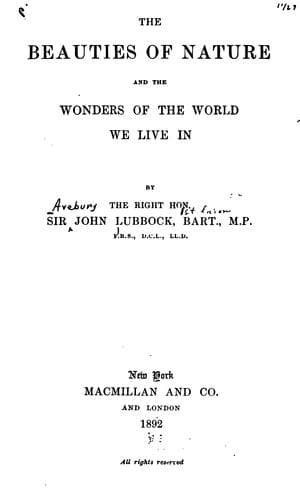
The Beauties of Nature, and the Wonders of the World We Live InLubbock, John, Sir
Philosophy
The Beauties of Nature, and the Wonders of the World We Live In
Lubbock, John, Sir
Astronomy; Natural history; Physical geography
At the same time the change which has taken place in the character of
our religion has in one respect weakened the hold which Nature has upon
our feelings. To the Greeks--to our own ancestors,--every River or
Mountain or Forest had not only its own special Deity, but in some sense
was itself instinct with life. They were not only peopled by Nymphs and
Fauns, Elves and Kelpies, were not only the favourite abodes of Water,
Forest, or Mountain Spirits, but they had a conscious existence of their
own.
In the Middle Ages indeed, these spirits were regarded as often
mischievous, and apt to take offence; sometimes as essentially
malevolent--even the most beautiful, like the Venus of Tannhaeuser, being
often on that very account all the more dangerous; while the Mountains
and Forests, the Lakes and Seas, were the abodes of hideous ghosts and
horrible monsters, of Giants and Ogres, Sorcerers and Demons. These
fears, though vague, were none the less extreme, and the judicial
records of the Middle Ages furnish only too conclusive evidence that
they were a terrible reality. The light of Science has now happily
dispelled these fearful nightmares.
Unfortunately, however, as men have multiplied, their energies have
hitherto tended, not to beautify, but to mar. Forests have been cut
down, and replaced by flat fields in geometrical squares, or on the
continent by narrow strips. Here and there indeed we meet with oases, in
which beauty has not been sacrificed to profit, and it is then happily
found that not only is there no loss, but the earth seems to reward even
more richly those who treat her with love and respect.
Scarcely any part of the world affords so great a variety in so small an
area as our own island. Commencing in the south, we have first the blue
sea itself, the pebbly beaches, the white chalk cliffs of Kent, the
tinted sands of Alum Bay, the Red Sandstone of Devonshire, Granite and
Gneiss in Cornwall: inland we have the chalk Downs and clear streams,
the well-wooded weald and the rich hop gardens; farther westwards the
undulating gravelly hills, and still farther the granite tors: in the
centre of England we have to the east the Norfolk Broads and the Fens;
then the fertile Midlands, the cornfields, rich meadows, and large oxen;
and to the west the Welsh mountains; farther north the Yorkshire Wolds,
the Lancashire hills, the Lakes of Westmoreland; lastly, the swelling
hills, bleak moors, and picturesque castles of Northumberland and
Cumberland.
There are of course far larger rivers, but perhaps none lovelier than
The crystal Thamis wont to glide
In silver channel, down along the lee,[5]
[Illustration: WINDSOR CASTLE.
_To face page 13._]
by lawns and parks, meadows and wooded banks, dotted with country houses
and crowned by Windsor Castle itself (see Frontispiece). By many
Scotland is considered even more beautiful.
Public-domain text, read in full here on John Shaqi.
Reviews
Reviews
No reviews yet
Be the first to share your thoughts on this work.
Join the Discussion
Join the discussion
Sign in to leave a comment or review.
Sign InorCreate an account