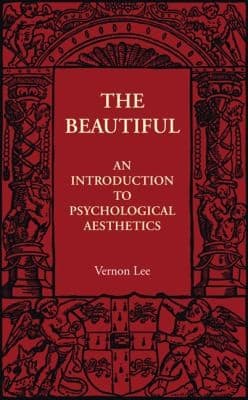
The Beautiful: An Introduction to Psychological Aesthetics — John Shaqi
The Beautiful: An Introduction to Psychological AestheticsLee, Vernon
Philosophy
The Beautiful: An Introduction to Psychological Aesthetics
Lee, Vernon
Aesthetics; Form (Aesthetics); Psychology, Applied
did not concern himself whether what he was looking at was an
aggregate of things; still less what might be these things' other
properties. He was not concerned with things at all, but only with a
particular appearance (he did not care whether it answered to reality),
only with one (he did not want to know whether there might be any
other) _aspect._
For, odd as it may sound, a _Thing_ is both much more and much
less than an _Aspect._ Much more, because a _Thing_ really means
not only qualities of its own and reactions of ours which are actual
and present, but a far greater number and variety thereof which are
potential. Much _less,_ on the other hand, because of these potential
qualities and reactions constituting a Thing only a minimum need be
thought of at any given time; instead of which, an aspect is all there,
its qualities closely interdependent, and our reactions entirely taken
up in connecting them as whole and parts. A rose, for instance, is
not merely a certain assemblage of curves and straight lines and
colours, seen as the painter sees it, at a certain angle, petals masking
part of stem, leaf protruding above bud: it is the possibility of other
combinations of shapes, including those seen when the rose (or the
person looking) is placed head downwards. Similarly it is the
possibility of certain sensations of resistance, softness, moisture,
pricking if we attempt to grasp it, of a certain fragrance if we breathe
in the air. It is the possibility of turning into a particular fruit, with
the possibility of our finding that fruit bitter and non-edible; of being
developed from cuttings, pressed in a book, made a present of or
cultivated for lucre. Only one of these groups of possibilities may
occupy our thoughts, the rest not glanced at, or only glanced at
subsequently; but if, on trial, any of these grouped possibilities
disappoint us, we decide that this is not a real rose, but a paper rose,
or a painted one, or no rose at all, but some _other thing._ For, so far
as our consciousness is concerned, _things_ are merely groups of
actual and potential reactions on our own part, that is to say of
expectations which experience has linked together in more or less
stable groups. The practical man and the man of science in my fable,
were both of them dealing with _Things_: passing from one group
of potential reaction to another, hurrying here, dallying there, till of
the actual _aspect_ of the landscape there remained nothing in their
thoughts, trams and funiculars in the future, volcanoes and icecaps
in the past, having entirely altered all that; only the material
constituents and the geographical locality remaining as the unshifted
item in those much pulled about bundles of thoughts of possibilities.
Public-domain text, read in full here on John Shaqi.
Reviews
Reviews
No reviews yet
Be the first to share your thoughts on this work.
Join the Discussion
Join the discussion
Sign in to leave a comment or review.
Sign InorCreate an account