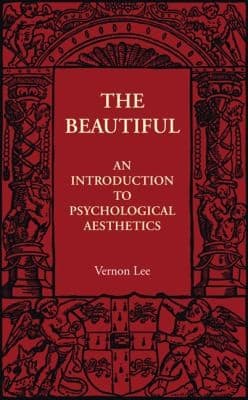
The Beautiful: An Introduction to Psychological Aesthetics — John Shaqi
The Beautiful: An Introduction to Psychological AestheticsLee, Vernon
Philosophy
The Beautiful: An Introduction to Psychological Aesthetics
Lee, Vernon
Aesthetics; Form (Aesthetics); Psychology, Applied
Every _thing_ may have a great number of very different _Aspects;_
and some of these _Aspects_ may invite contemplation, as that
landscape invited the third man to contemplate it; while other
_aspects_ (say the same place after a proper course of tramways and
funiculars and semi-detached residences, or _before_ the needful
volcanic and glacial action) may be such as are dismissed or slurred
as fast as possible. Indeed, with the exception of a very few cubes
not in themselves especially attractive, I cannot remember any
_things_ which do not present quite as many displeasing aspects as
pleasing ones. The most beautiful building is not beautiful if stood
on its head; the most beautiful picture is not beautiful looked at
through a microscope or from too far off; the most beautiful melody
is not beautiful if begun at the wrong end. . . . Here the Reader may
interrupt: "What nonsense! Of course the building _is_ a building
only when right side up; the picture isn't a picture any longer under a
microscope; the melody isn't a melody except begun at the
beginning"--all which means that when we speak of a building, a
picture, or a melody, we are already implicitly speaking, no longer
of a _Thing,_ but of one of the possible _Aspects_ of a thing; _and
that when we say that a thing is beautiful, we mean that it affords
one or more aspects which we contemplate with satisfaction._ But if
a beautiful mountain or a beautiful woman could only be
_contemplated,_ if the mountain could not also be climbed or
tunnelled, if the woman could not also get married, bear children
and have (or not have!) a vote, we should say that the mountain and
the woman were not _real things._ Hence we come to the conclusion,
paradoxical only as long as we fail to define what we are talking
about, _that what we contemplate as beautiful is an Aspect of a
Thing, but never a Thing itself._ In other words: Beautiful is an
adjective applicable to Aspects not to Things, or to Things only,
inasmuch as we consider them as possessing (among other
potentialities) beautiful Aspects. So that we can now formulate:
_The word beautiful implies the satisfaction derived from the
contemplation not of things but of aspects._
Public-domain text, read in full here on John Shaqi.
Reviews
Reviews
No reviews yet
Be the first to share your thoughts on this work.
Join the Discussion
Join the discussion
Sign in to leave a comment or review.
Sign InorCreate an account