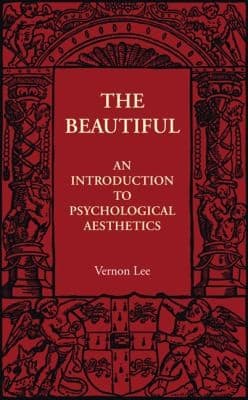
The Beautiful: An Introduction to Psychological AestheticsLee, Vernon
Philosophy
The Beautiful: An Introduction to Psychological Aesthetics
Lee, Vernon
Aesthetics; Form (Aesthetics); Psychology, Applied
This summing up has brought us to the very core of our subject; and
I should wish the Reader to get it by heart, until he grow
familiarised therewith in the course of our further examinations.
Before proceeding upon these, I would, however, ask him to reflect
how this last formula of ours bears upon the old, seemingly endless,
squabble as to whether or not beauty has anything to do with truth,
and whether art, as certain moralists contend, is a school of lying.
For _true_ or _false_ is a judgment of existence; it refers to
_Things;_ it implies that besides the qualities and reactions shown
or described, our further action or analysis will call forth certain
other groups of qualities and reactions constituting the _thing which
is said to exist._ But aspects, in the case in which I have used that
word, _are_ what they are and do not necessarily imply anything
beyond their own peculiarities. The words _true_ or _false_ can be
applied to them only with the meaning of _aspects truly existing_ or
_not truly existing;_ _i.e._ aspects of which it is true or not to _say
that they exist._ But as to an aspect being true or false in the sense
of _misleading,_ that question refers not to the _aspect_ itself, but to
the thing of which the aspect is taken as a part and a sign. Now the
contemplation of the mere aspect, the beauty (or ugliness) of the
aspect, does not itself necessitate or imply any such reference to a
thing. Our contemplation of the beauty of a statue representing a
Centaur may indeed be disturbed by the reflexion that a creature
with two sets of lungs and digestive organs would be a monster and
not likely to grow to the age of having a beard. But this disturbing
thought need not take place. And when it takes place it is not part of
our contemplation of the _aspect_ of that statue; it is, on the contrary,
outside it, an excursion away from it due to our inveterate (and very
necessary) habit of interrupting the contemplation of _Aspects_ by
the thinking and testing of _Things._ The Aspect never implied the
existence of a Thing beyond itself; it did not affirm that anything
was true, _i.e._ that anything could or would happen besides the fact
of our contemplation. In other words the formula that _beautiful is
an adjective applying only to aspects,_ shows us that art can be
truthful or untruthful only in so far as art (as is often the case)
deliberately sets to making statements about the existence and nature
of Things. If Art says "Centaurs can be born and grow up to man's
estate with two sets of respiratory and digestive organs"--then Art is
telling lies. Only, before accusing it of being a liar, better make sure
that the statement about the possibility of centaurs has been intended
by the Art, and not merely read into it by ourselves.
But more of this when we come to the examination of Subject and
Form.
CHAPTER IV
SENSATIONS
Public-domain text, read in full here on John Shaqi.
Reviews
Reviews
No reviews yet
Be the first to share your thoughts on this work.
Join the Discussion
Join the discussion
Sign in to leave a comment or review.
Sign InorCreate an account