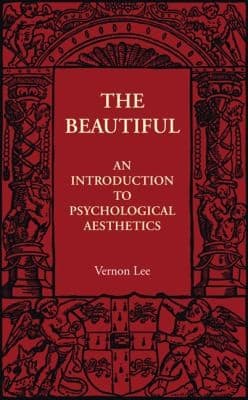
The Beautiful: An Introduction to Psychological AestheticsLee, Vernon
Philosophy
The Beautiful: An Introduction to Psychological Aesthetics
Lee, Vernon
Aesthetics; Form (Aesthetics); Psychology, Applied
The case of RYTHM is more complex. For, although we usually
think of Rythm as a relation of _two_ items, it is in reality a relation
of four (or more ); because what we remember and expect is a
mixture of similarity with dissimilarity between lengths, directions
or impacts. OR IMPACTS. For with Rythm we come to another
point illustrative of the fact that all shape-elements depend upon our
own activity and its modes. A rythmical arrangement is not
necessarily one between _objectively_ alternated elements like
objectively longer or shorter lines of a pattern, or _objectively_
higher or lower or longer and shorter notes. Rythm exists equally
where the objective data, the sense stimulations, are uniform, as is
the case with the ticks of a clock. These ticks would be registered as
exactly similar by appropriate instruments. But our mind is not such
an impassive instrument: our mind (whatever our mind may really
be) is subject to an alternation of _more_ and _less,_ of _vivid_ and
_less vivid, important_ and _less important,_ of _strong_ and
_weak;_ and the objectively similar stimulations from outside, of
sound or colour or light, are perceived as vivid or less vivid,
important or less important, according to the beat of this mutual
alternation with which they coincide: thus the uniform, ticking of the
clock will be perceived by us as a succession in which the stress,
that is the importance, is thrown upon the first or the second member
of a group; and the recollection and expectation are therefore of a
unity of dissimilar importance. We hear STRONG-WEAK; and
remembering _strong-weak,_ we make a new _strong-weak_ out of
that objective uniformity. Here there is no objective reason for one
rythm more than another; and we express this by saying that the
tickings of a clock have no intrinsic form. For _Form,_ or as I prefer
to call it, _Shape,_ although it exists only in the mind capable of
establishing and correlating its constituent relationships, takes an
objective existence when the material stimulations from the outer
world are such as to force all normally constituted minds to the same
series and combinations of perceptive acts; a fact which explains
why the artist can transmit the shapes existing in his own mind to
the mind of a beholder or hearer by combining certain objective
stimulations, say those of pigments on paper or of sound vibrations
in time, so as to provoke perceptive activities similar to those which
would, _ceteris paribus,_ have been provoked in himself if that
shape had not existed first of all _only_ in his mind.
Public-domain text, read in full here on John Shaqi.
Reviews
Reviews
No reviews yet
Be the first to share your thoughts on this work.
Join the Discussion
Join the discussion
Sign in to leave a comment or review.
Sign InorCreate an account