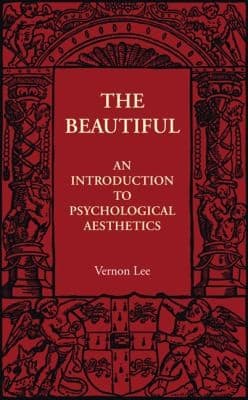
The Beautiful: An Introduction to Psychological AestheticsLee, Vernon
Philosophy
The Beautiful: An Introduction to Psychological Aesthetics
Lee, Vernon
Aesthetics; Form (Aesthetics); Psychology, Applied
A further illustration of the principle that shape-perception is a
combination of active measurements and comparisons, and of
remembrance and expectations, is found in a fact which has very
great importance in all artistic dealings with shapes. I have spoken,
for simplicity's, sake, as if the patches of colour on a blank (i.e.
uninteresting) ground along which the glance sweeps, were
invariably contiguous and continuous. But these colour patches, and
the sensations they afford us, are just as often, discontinuous in the
highest degree; and the lines constituting a shape may, as for
instance in constellations, be entirely imaginary. The fact is that
what we feel as a line is not an objective continuity of
colour-or-light-patches, but the continuity of our glance's sweep which
may either accompany this objective continuity or replace it. Indeed
such imaginary lines thus established between isolated colour patches,
are sometimes felt as more vividly existing than real ones, because the
glance is not obliged to take stock of their parts, but can rush freely
from extreme point to extreme point. Moreover not only half the
effectiveness of design, but more than half the efficiency of practical
life, is due to our establishing such imaginary lines. We are
inevitably and perpetually dividing visual space (and something of
the sort happens also with "musical space") by objectively
non-existent lines answering to our own bodily orientation. Every course,
every trajectory, is of this sort. And every drawing executed by an
artist, every landscape, offered us by "Nature," is felt, because it is
measured, with reference to a set of imaginary horizontals or
perpendiculars. While, as I remember the late Mr G. F. Watts
showing me, every curve which we look at is _felt as being_ part of
an imaginary circle into which it could be prolonged. Our sum of
measuring and comparing activities, and also our dramas of
remembrance and expectation, are therefore multiplied by these
imaginary lines, whether they connect, constellation-wise, a few
isolated colour indications, or whether they are established as
standards of reference (horizontals, verticals, etc.) for other really
existing lines; or whether again they be thought of, like those circles,
as _wholes_ of which objectively perceived series of colour patches
might possibly be _parts._ In all these cases imaginary lines are
_felt,_ as existing, inasmuch as we feel the movement by which we
bring them into existence, and even feel that such a movement might
be made by us when it is not.
So far, however, I have dealt with these imaginary lines only as an
additional proof that shape-perception is an establishment of two
dimensional relationships, through our own activities, and an active
remembering, foreseeing and combining thereof.
CHAPTER VII
FACILITY AND DIFFICULTY OF GRASPING
Public-domain text, read in full here on John Shaqi.
Reviews
Reviews
No reviews yet
Be the first to share your thoughts on this work.
Join the Discussion
Join the discussion
Sign in to leave a comment or review.
Sign InorCreate an account