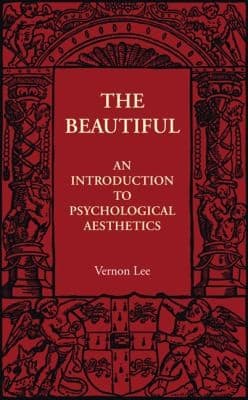
The Beautiful: An Introduction to Psychological AestheticsLee, Vernon
Philosophy
The Beautiful: An Introduction to Psychological Aesthetics
Lee, Vernon
Aesthetics; Form (Aesthetics); Psychology, Applied
When did I say or imply that he was _aware_ of doing any of it? It is
not only possible, but extremely common, to perform processes
without being aware of performing them. The man was not _aware,_
for instance, of making eye adjustments and eye movements, unless
indeed his sight was out of order. Yet his eye movements could have
been cinematographed, and his eye adjustments have been described
minutely in a dozen treatises. He was no more aware of _doing_ any
measuring or comparing than we are aware of _doing_ our digestion
or circulation, except when we do them badly. But just as we are
aware of our digestive and circulatory processes in the sense of
being aware of the animal spirits resulting from their adequate
performance, so he was aware of his measuring and comparing,
inasmuch as he was aware that the line A--B was longer than the
line C--D, or that the point E was half an inch to the left of the point
F. For so long as we are neither examining into ourselves, nor called
upon to make a choice between two possible proceedings, nor forced
to do or suffer something difficult or distressing, in fact so long as
we are attending to whatever absorbs our attention and not to our
processes of attending, those processes are replaced in our
awareness by the very facts--for instance the proportions and
relations of lines--resulting from their activity. That these results
should not resemble their cause, that mental elements (as they are
called) should appear and disappear, and also combine into
unaccountable compounds (Browning's "not a third sound, but a
star") according as we attend to them, is indeed the besetting
difficulty of a science carried on by the very processes which it
studies. But it is so because it is one of Psychology's basic facts.
And, so far as we are at present concerned, this difference between
mental processes and their results is the fact upon which
psychological aesthetics are based. And it is not in order to convert
the Man on the Hill to belief in his own acts of shape-perception,
nor even to explain why he was not aware of them, that I am
insisting upon this point. The principle I have been expounding, let
us call it that of the _merging of the perceptive activities of the
subject in the qualities of the object of perception,_ explains another
and quite as important mental process which was going on in that
unsuspecting man.
Public-domain text, read in full here on John Shaqi.
Reviews
Reviews
No reviews yet
Be the first to share your thoughts on this work.
Join the Discussion
Join the discussion
Sign in to leave a comment or review.
Sign InorCreate an account