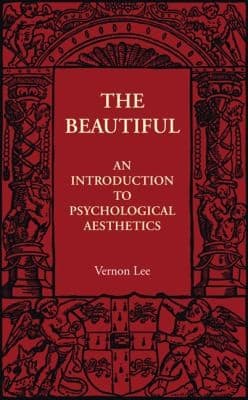
The Beautiful: An Introduction to Psychological Aesthetics — John Shaqi
The Beautiful: An Introduction to Psychological AestheticsLee, Vernon
Philosophy
The Beautiful: An Introduction to Psychological Aesthetics
Lee, Vernon
Aesthetics; Form (Aesthetics); Psychology, Applied
But before proceeding to that I must make it clearer how that man
stood in the matter of _awareness of himself._ He was, indeed,
aware of himself whenever, during his contemplation of that
landscape, the thought arose, "well, I must be going away, and
perhaps I shan't see this place again"--or some infinitely abbreviated
form, perhaps a mere sketched out gesture of turning away,
accompanied by a slight feeling of _clinging,_ he couldn't for the
life of him say in what part of his body. He was at that moment
acutely aware that he _did not want_ to do something which it was
optional to do. Or, if he acquiesced passively in the necessity of
going away, aware that he _wanted to come back,_ or at all events
wanted to carry off as much as possible of what he had seen. In short
he was aware of himself either making the effort of tearing himself
away, or, if some other person or mere habit, saved him this effort,
he was aware of himself making another effort to impress that
landscape on his memory, and aware of a future self making an
effort to return to it. I call it _effort_; you may, if you prefer, call it
will; at all events the man was aware of himself as nominative of a
verb to _cling to,_ (in the future tense) _return to,_ to _choose as
against some other alternative_; as nominative of a verb briefly, _to
like_ or _love._ And the accusative of these verbs would be the
landscape. But unless the man's contemplation was thus shot with
similar ideas of some action or choice of his own, he would express
the situation by saying "this landscape _is_ awfully beautiful."
This IS. I want you to notice the formula, by which the landscape,
ceasing to be the accusative of the man's looking and thinking,
becomes the nominative of a verb _to be so-and-so._ That
grammatical transformation is the sign of what I have designated, in
philosophical language, _as the merging of the activities of the
subject in the object._ It takes place already in the domain of simple
sensation whenever, instead of saying "_I_ taste or _I_ smell
something nice or nasty" we say--"_this thing_ tastes or smells nice
or nasty." And I have now shown you how this tendency to put the
cart before the horse increases when we pass to the more complex
and active processes called perception; turning "I measure this
line"--"I compare these two angles" into "this line _extends_ from A to
B"--"these two angles _are equal_ to two right angles."
Public-domain text, read in full here on John Shaqi.
Reviews
Reviews
No reviews yet
Be the first to share your thoughts on this work.
Join the Discussion
Join the discussion
Sign in to leave a comment or review.
Sign InorCreate an account