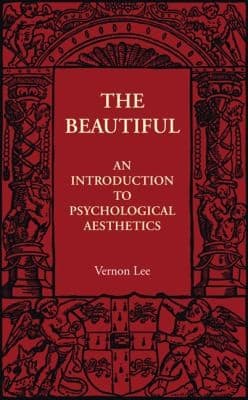
The Beautiful: An Introduction to Psychological Aesthetics — John Shaqi
The Beautiful: An Introduction to Psychological AestheticsLee, Vernon
Philosophy
The Beautiful: An Introduction to Psychological Aesthetics
Lee, Vernon
Aesthetics; Form (Aesthetics); Psychology, Applied
But before getting to the final inversion--"this landscape _is_
beautiful" instead of "_I_ like this landscape"--there is yet another,
and far more curious merging of the subject's activities in the
qualities of the object. This further putting of the cart before the
horse (and, you will see, attributing to the cart what only the horse
can be doing!) falls under the head of what German psychologists
call _Einfühlung,_ or "Infeeling"--which Prof. Titchener has
translated _Empathy._ Now this new, and comparatively newly
discovered element in our perception of shape is the one to which,
leaving out of account the pleasantness of mere colour and sound
sensations as such, we probably owe the bulk of whatever
satisfaction we connect with the word Beautiful. And I have already
given the Reader an example of such Empathy when I described the
landscape seen by the man on the hill as consisting of a skyline
"_dropping down merely to rush up again in rapid concave curves_";
to which I might have added that there was also a plain which
_extended,_ a valley which _wound along,_ paths which _climbed_
and roads which _followed_ the _undulations_ of the land. But the
best example was when I said that opposite to the man there was a
distant mountain _rising_ against the sky.
CHAPTER IX
EMPATHY
_THE mountain rises._ What do we mean when we employ this
form of words? Some mountains, we are told, have originated in an
_upheaval._ But even if this particular mountain did, we never saw
it and geologists are still disputing about HOW and WHETHER. So
the _rising_ we are talking about is evidently not that probable or
improbable _upheaval._ On the other hand all geologists tell us that
every mountain is undergoing a steady _lowering_ through its
particles being weathered away and washed down; and our
knowledge of landslips and avalanches shows us that the mountain,
so far from rising, is _descending._ Of course we all know that,
objects the Reader, and of course nobody imagines that the rock and
the earth of the mountain is rising, or that the mountain is getting up
or growing taller! All we mean is that the mountain _looks_ as if it
were rising.
The mountain _looks!_ Surely here is a case of putting the cart
before the horse. No; we cannot explain the mountain _rising_ by
the mountain _looking,_ for the only _looking_ in the business is
_our_ looking _at_ the mountain. And if the Reader objects again
that these are all _figures of speech,_ I shall answer that _Empathy_
is what explains why we employ figures of speech at all, and
occasionally employ them, as in the case of this rising mountain,
when we know perfectly well that the figure we have chosen
expresses the exact reverse of the objective truth. Very well; then,
(says the Reader) we will avoid all figures of speech and say merely:
when we look at the mountain _we somehow or other think of the
action of rising._ Is that sufficiently literal and indisputable?
Public-domain text, read in full here on John Shaqi.
Reviews
Reviews
No reviews yet
Be the first to share your thoughts on this work.
Join the Discussion
Join the discussion
Sign in to leave a comment or review.
Sign InorCreate an account