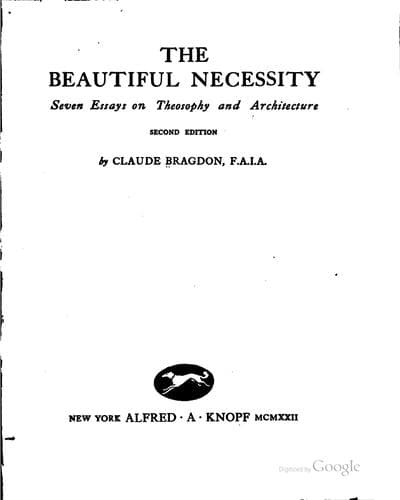
The Beautiful Necessity: Seven Essays on Theosophy and ArchitectureBragdon, Claude Fayette
Philosophy
The Beautiful Necessity: Seven Essays on Theosophy and Architecture
Bragdon, Claude Fayette
Architecture; Theosophy
UNITY AND POLARITY
Theosophy, both as a philosophy, or system of thought, which discovers
correlations between things apparently unrelated, and as a life,
or system of training whereby it is possible to gain the power to
perceive and use these correlations for worthy ends, is of great value
to the creative artist, whose success depends on the extent to which
he works organically, conforming to the cosmic pattern, proceeding
rationally and rhythmically to some predetermined end. It is of value
no less to the layman, the critic, the art amateur--to anyone in
fact who would come to an accurate and intimate understanding and
appreciation of every variety of esthetic endeavor. For the benefit of
such I shall try to trace some of those correlations which theosophy
affirms, and indicate their bearing upon art, and upon the art of
architecture in particular.
One of the things which theosophy teaches is that those transcendent
glimpses of a divine order and harmony throughout the universe
vouchsafed the poet and the mystic in their moments of vision are not
the paradoxes--the paronomasia as it were--of an intoxicated state of
consciousness, but glimpses of reality. We are all of us participators
in a world of concrete music, geometry and number--a world of
sounds, odors, forms, motions, colors, so mathematically related and
coordinated that our pigmy bodies, equally with the farthest star,
vibrate to the music of the spheres. There is a _Beautiful Necessity_
which rules the world, which is a law of nature and equally a law of
art, for art is idealized creation: nature carried to a higher power
by reason of its passage through a human consciousness. Thought and
emotion tend to crystallize into forms of beauty as inevitably as does
the frost on a window pane. Art therefore in one of its aspects is the
weaving of a pattern, the communication of an order and a method to
the material or medium employed. Although no masterpiece was ever
created by the conscious following to set rules, for the true artist
works unconsciously, instinctively, as the bird sings or as the bee
builds its honey-cell, yet an analysis of any masterpiece reveals the
fact that its author (like the bird and the bee) has "followed the
rules without knowing them."
Helmholtz says, "No doubt is now entertained that beauty is subject
to laws and rules dependent on the nature of human intelligence. The
difficulty consists in the fact that these laws and rules, on whose
fulfilment beauty depends, are not consciously present in the mind of
the artist who creates the work, or of the observer who contemplates
it." Nevertheless they are discoverable, and can be formulated,
after a fashion. We have only to read aright the lessons everywhere
portrayed in the vast picture-books of nature and of art.
Public-domain text, read in full here on John Shaqi.
Reviews
Reviews
No reviews yet
Be the first to share your thoughts on this work.
Join the Discussion
Join the discussion
Sign in to leave a comment or review.
Sign InorCreate an account