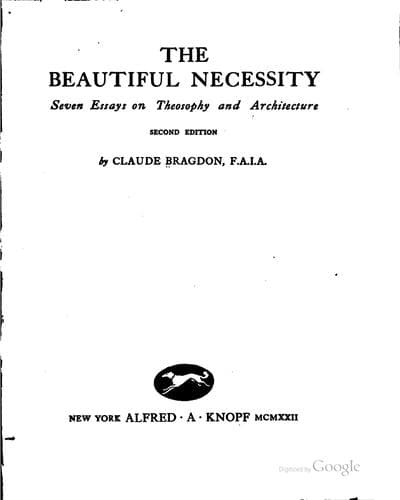
The Beautiful Necessity: Seven Essays on Theosophy and ArchitectureBragdon, Claude Fayette
Philosophy
The Beautiful Necessity: Seven Essays on Theosophy and Architecture
Bragdon, Claude Fayette
Architecture; Theosophy
The first truth therein published is the law of _Unity_--oneness; for
there is one Self, one Life, which, myriad in manifestation, is yet
in essence ever _one_. Atom and universe, man and the world--each is
a unit, an organic and coherent whole. The application of this law to
art is so obvious as to be almost unnecessary of elucidation, for to
say that a work of art must possess unity, must seem to proceed from a
single impulse and be the embodiment of one dominant idea, is to state
a truism. In a work of architecture the coördination of its various
parts with one another is almost the measure of its success. We
remember any masterpiece--the cathedral of Paris no less than the
pyramids of Egypt--by the singleness of its appeal; complex it may be,
but it is a coordinated complexity; variety it may possess, but it is
a variety in an all-embracing unity.
The second law, not contradicting but supplementing the first is the
law of _Polarity_, i.e., duality. All things have sex, are either
masculine or feminine. This too is the reflection on a lower plane
of one of those transcendental truths taught by the Ancient Wisdom,
namely that the Logos, in his voluntarily circumscribing his infinite
life in order that he may manifest, encloses himself within his
limiting veil, _maya_, and that his life appears as spirit (male), and
his _maya_ as matter (female), the two being never disjoined during
manifestation. The two terms of this polarity are endlessly repeated
throughout nature: in sun and moon, day and night, fire and water, man
and woman--and so on. A close inter-relation is always seen to subsist
between corresponding members of such pairs of opposites: sun, day,
fire, man express and embody the primal and active aspect of the
manifesting deity; moon, night, water, woman, its secondary and
passive aspect. Moreover, each implies or brings to mind the others
of its class: man, like the sun, is lord of day; he is like fire, a
devastating force; woman is subject to the lunar rhythm; like water,
she is soft, sinuous, fecund.
The part which this polarity plays in the arts is important, and the
constant and characteristic distinction between the two terms is a
thing far beyond mere contrast.
Public-domain text, read in full here on John Shaqi.
Reviews
Reviews
No reviews yet
Be the first to share your thoughts on this work.
Join the Discussion
Join the discussion
Sign in to leave a comment or review.
Sign InorCreate an account