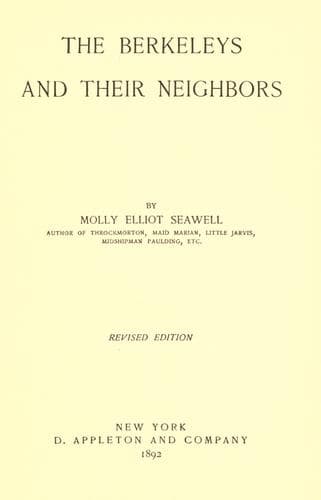
The Berkeleys and their neighborsSeawell, Molly Elliot
General
The Berkeleys and their neighbors
Seawell, Molly Elliot
Virginia -- Fiction
“Have you seen Elise--Madame Koller--lately?” The first name slipped
out involuntarily. He rarely called Madame Koller by it at any
time--but now, by one of those tricks which memory serves all people,
her name came to his lips not only without his will, but against it.
His face turned a deep red, and he bit his lip in anger and vexation.
Olivia straightened herself up on her horse and smiled at him that
peculiar indulgent smile, and addressed him in those gentle tones that
betokened the freezing up of her sympathies and the coming to life
of her contempt. He knew only too well the meaning of that appalling
sweetness. “No, I have not. But to-morrow I will probably see her.
Shall I remember you to her?”
“If you please,” replied Pembroke, wishing Madame Koller at the devil,
as he often did. Often--but not always.
Then they drifted into commonplace, and presently they parted, Pembroke
galloping back to the village, despising himself almost as much as the
day he had allowed his anger to lead him into the quarrel with Ahlberg.
But when he reached his dingy little office, Olivia Berkeley, Madame
Koller, Ahlberg, all faded rapidly out of his mind. That great game
of skill in which he was engaged, the stake being a human life, again
absorbed him. And then the critical time came, when, after having
tried to prove that the negro’s blow had not killed Hackett, he had
to bring out his theory that a dead and missing man was the murderer.
Hackett’s boon companions, who formed a community of lawless loafers,
had been unaccountably shy about attending the trial. Like the rest
of their class, they regarded a sensational murder trial as the most
fascinating occasion in life. They were great frequenters of the court
house, particularly of its low drinking places during “court week,”
but not one of them showed up in the first days of the trial. Cave
brought this significant news to Pembroke, who knew few persons in
the miscellaneous crowd that he saw every day. It made his heart beat
hard and fast with the hope of a coming success. The Hibbses and their
retainers, and a certain set of people who overcame their dislike to
the Hibbs family out of exaggerated sympathy for a Northern man with
Southern sympathies, for which Hackett had posed, formed a kind of camp
to themselves in the court room.
The lawyers for the State found out that Pembroke knew all the weak
spots in their theory that Bob Henry’s blow killed Hackett, but there
was no suspicion of any evidence forthcoming to support Pembroke’s
theory that another hand struck the blow. Hackett’s association with
the deserters had evidently been carefully concealed by him, as it
would have ostracized him utterly.
Public-domain text, read in full here on John Shaqi.
Reviews
Reviews
No reviews yet
Be the first to share your thoughts on this work.
Join the Discussion
Join the discussion
Sign in to leave a comment or review.
Sign InorCreate an account