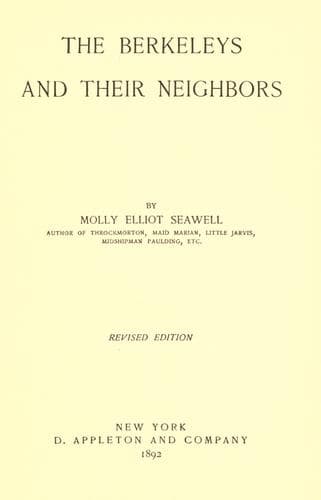
The Berkeleys and their neighborsSeawell, Molly Elliot
General
The Berkeleys and their neighbors
Seawell, Molly Elliot
Virginia -- Fiction
Therefore, when Pembroke, putting off until the last possible moment,
summoned John Jones and George Robinson and about a dozen others of
the “deserters’ gang,” as it was called, his opponents were taken
by surprise. One day only was taken up with their evidence. Each
witness, debarred by Judge Randolph’s orders from communicating with
the other, told a rambling, lying, frightened story, out of which
Pembroke gleaned the midnight carousal, a quarrel, a blow--all of them
running away, and leaving Hackett to his fate. In one point, however,
they all agreed--that the man, William Marsh, who was fearfully cut by
Hackett’s knife, and who disappeared to die, was the one who struck
the fatal blow that knocked Hackett senseless, and from which he never
rallied. All were eager to lay it on the dead man, and so to shift
the suspicion from themselves. The State, of course, impugned the
character of the witnesses, but that was a work of supererogation.
They had no characters to impugn. Yet, both judge and jury saw, that
without the slightest objection to perjuring themselves on the part of
this precious gang, they were involuntarily proving that Marsh, not
Bob Henry, was the murderer. Then Cave’s protégé, a small, ragged,
undersized boy of fifteen, was introduced. He was diffident, and shy,
and trembling in every limb, but his testimony was perfectly plain and
straightforward, so much so that an eminent gentleman on the side of
the prosecution, roared out to him, “Now, young man, tell us if this
remarkably straight story of yours didn’t have help from somewhere.
Have you talked with anybody about this evidence?”
“Y--y--yes, sir,” stammered the boy, frightened half out of his life.
“Who was it?” thundered the lawyer.
“Mr.--Mr.--Cave.”
“Aha, I thought so. Now, sir, tell us what Mr. Cave said to you--and be
careful--very careful.”
The boy looked perfectly helpless and hopeless for a moment. Pembroke
almost felt himself tremble.
“He said--he said, sir, some of the lawyers would holler at me, and
maybe confuse me--but if I jes’ stuck to the truth, and didn’t tell
nothin’ but what I seen with my own eyes, I’d come out all right!”
Shouts of applause greeted this, which the sheriff vainly tried to
quell. The great man remarked to his personal staff, _sotto voce_,
“It’s all up. Pembroke’s case is too strong for us.”
It was late in the afternoon of the fifth day when Pembroke’s closing
argument was over, and the jury had been instructed and had retired.
The Judge’s instructions rather damped Pembroke’s hopes. The testimony
of the deserters, while actually of great effect, was legally not worth
much--their motive in shoveling the blame on Marsh was too obvious. And
Cave’s protégé, although his testimony was remarkably straightforward,
was little better than a vagabond boy. Pembroke was not so sanguine of
his own success as his opponents were.
Public-domain text, read in full here on John Shaqi.
Reviews
Reviews
No reviews yet
Be the first to share your thoughts on this work.
Join the Discussion
Join the discussion
Sign in to leave a comment or review.
Sign InorCreate an account