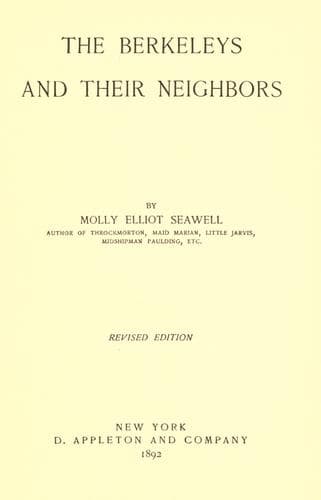
The Berkeleys and their neighborsSeawell, Molly Elliot
General
The Berkeleys and their neighbors
Seawell, Molly Elliot
Virginia -- Fiction
The court house was dimly lighted by a few sputtering candles and an
ill-burning lamp. The Judge sat up straight and stern, fatigued with
the long trial, but willing to wait until six o’clock, the usual hour
of adjournment, for the jury. The shabby court-room was filled with
men, eager, talkative, but almost breathless with excitement--for by
some occult means, they divined that the jury wouldn’t be long making
up its verdict.
The negro sat in the dock, more ghastly, more ashy than ever. Pembroke
rose to go to his office. He felt his iron nerve beginning to give way,
but a voice--piteous and pleading--reached him.
“Fur God’s sake, Marse French, doan’ go ’way. I want you fur ter stay
by me.”
Pembroke sat down again, this time a little nearer the poor prisoner,
whose eyes followed him like a dog’s.
A hush settled down upon the audience. There was no pretense of
attending to any other business. The opposing lawyers rested wearily in
uncomfortable postures about the court-room. They talked in whispers
among themselves. Pembroke knew by instinct what they were saying. It
was that the jury was hopelessly gone, but that there remained hope yet
in the stern and silent Judge, whose instructions had been brief and
in no way indicative of which way his judgment inclined. It was not
the result of this trial which concerned them, it was the prospect of
another.
Among practiced lawyers, nothing is easier to tell than the views of a
judge on a criminal case--after the decision has been rendered. About
an hour of the suspense had been endured when a message came that the
jury had agreed upon a verdict. The expectant crowd suddenly became
hushed and motionless. Not as wise as the lawyers, there was utter
uncertainty among them as to--not only whether the prisoner was guilty
or not, but whether Pembroke alone and single-handed, had vanquished
the veterans before him.
The jury filed in and took their places, and the formalities were gone
through, when the foreman said in a loud voice, “Not guilty.” A wild
and tumultuous cheering broke forth. Like the poor prisoner, Pembroke
felt dazed. The end was not yet by any means. The opposing lawyers were
on their feet in a moment--the sheriff shouted for order--and in the
midst of this, a sudden silence came and Pembroke found himself--he
hardly knew how--on the platform shaking hands with Judge Randolph.
“I congratulate you, sir,” he heard the Judge’s voice saying afar off.
“You have maintained the reputation of your distinguished father for
the tact and judgment with which you have defended your client. You
have a great career before you. It is most encouraging to see such an
example among the younger members of the bar.”
Then there was a wild commotion. Pembroke felt himself choking,
trembling, utterly unable to reply. The pause to hear what he would say
became painfully prolonged. He began “Your Honor”--and after repeating
it twice, became utterly dumb.
Public-domain text, read in full here on John Shaqi.
Reviews
Reviews
No reviews yet
Be the first to share your thoughts on this work.
Join the Discussion
Join the discussion
Sign in to leave a comment or review.
Sign InorCreate an account