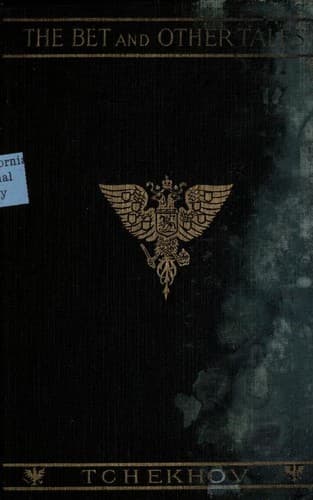
The Bet, and other storiesChekhov, Anton Pavlovich
General
The Bet, and other stories
Chekhov, Anton Pavlovich
Russian fiction -- Translations into English; Short stories, Russian -- Translations into English
Anyhow for eighteen months or a couple of years everything seemed
to be all right. Katy was in love, had her heart in her business
and was happy. But later on I began to notice clear symptoms of a
decline in her letters. It began with Katy complaining about her
friends. This is the first and most ominous sign. If a young scholar
or littérateur begins his career by complaining bitterly about other
scholars or littérateurs, it means that he is tired already and not
fit for his business. Katy wrote to me that her friends would not
come to rehearsals and never knew their parts; that they showed an
utter contempt for the public in the absurd plays they staged and
the manner they behaved. To swell the box-office receipts--the only
topic of conversation--serious actresses degrade themselves by singing
sentimentalities, and tragic actors sing music-hall songs, laughing at
husbands who are deceived and unfaithful wives who are pregnant. In
short, it was amazing that the profession, in the provinces, was not
absolutely dead. The marvel was that it could exist at all with such
thin, rotten blood in its veins.
In reply I sent Katy a long and, I confess, a very tedious letter.
Among other things I wrote: “I used to talk fairly often to actors in
the past, men of the noblest character, who honoured me with their
friendship. From my conversations with them I understood that their
activities were guided rather by the whim and fashion of society than
by the free working of their own minds. The best of them in their
lifetime had to play in tragedy, in musical comedy, in French farce,
and in pantomime; yet all through they considered that they were
treading the right path and being useful. You see that this means
that you must look for the cause of the evil, not in the actors, but
deeper down, in the art itself and the attitude of society towards
it.” This letter of mine only made Katy cross. “You and I are playing
in different operas. I didn’t write to you about men of the noblest
character, but about a lot of sharks who haven’t a spark of nobility in
them. They are a horde of savages who came on the stage only because
they wouldn’t be allowed anywhere else. The only ground they have for
calling themselves artists is their impudence. Not a single talent
among them, but any number of incapables, drunkards, intriguers, and
slanderers. I can’t tell you how bitterly I feel it that the art I love
so much is fallen into the hands of people I despise. It hurts me that
the best men should be content to look at evil from a distance and
not want to come nearer. Instead of taking an active part, they write
ponderous platitudes and useless sermons....” and more in the same
strain.
A little while after I received the following: “I have been inhumanly
deceived. I can’t go on living any more. Do as you think fit with my
money. I loved you as a father and as my only friend. Forgive me.”
Public-domain text, read in full here on John Shaqi.
Reviews
Reviews
No reviews yet
Be the first to share your thoughts on this work.
Join the Discussion
Join the discussion
Sign in to leave a comment or review.
Sign InorCreate an account